
- This event has passed.
Insurance, Risk, and Resilience in a Changing World
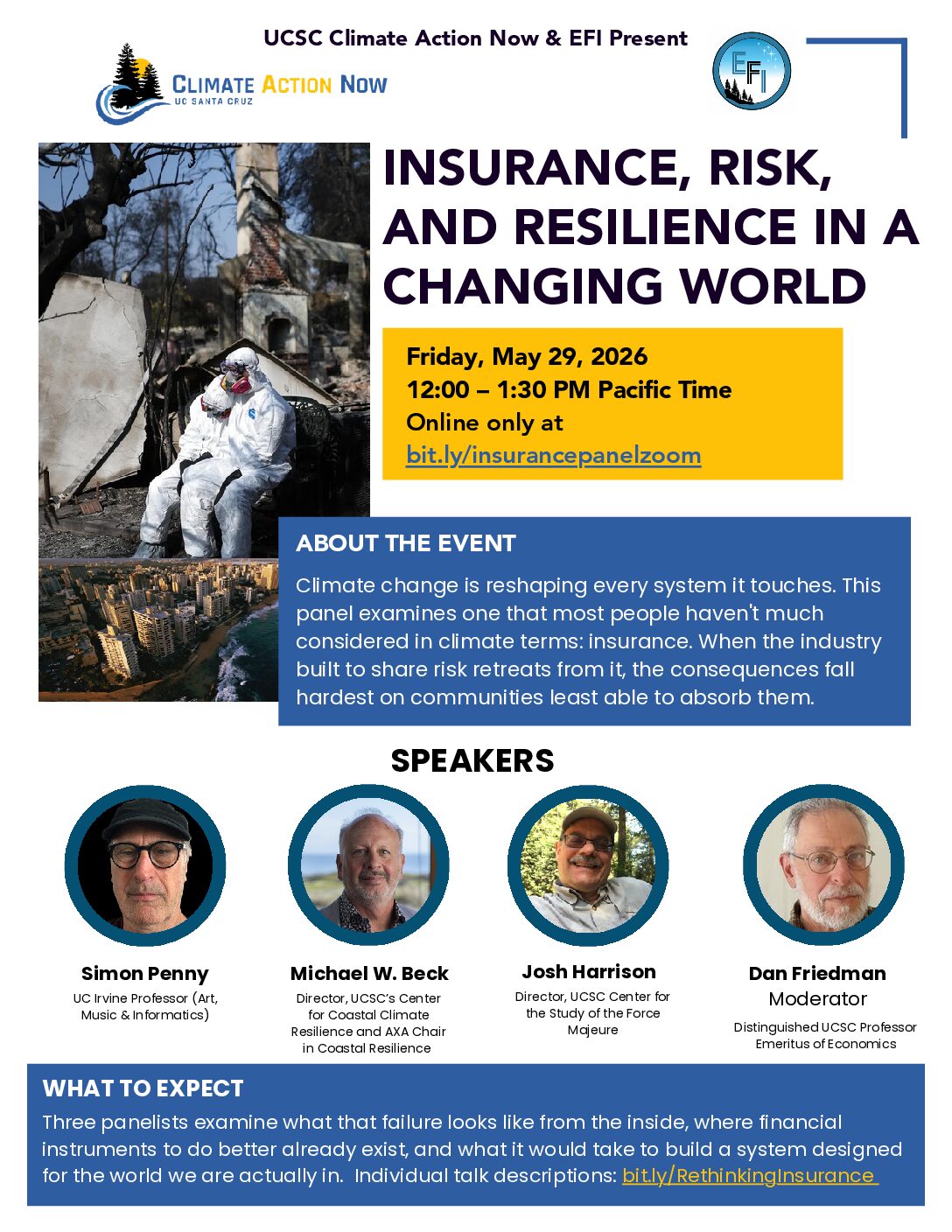
Climate change is reshaping every system it touches. This panel examines one that most people haven’t much considered in climate terms: insurance. When the industry built to share risk retreats from it, the consequences fall hardest on communities least able to absorb them. Three panelists examine what that failure looks like from the inside, where financial instruments to do better already exist, and what it would take to build a system designed for the world we are actually in.
UCI’s Simon Penny takes us to the heart of the problem. While for most, the Eaton Fire is a dim memory, Penny is (still) an evacuee. In Jan ‘25, nearly 10,000 buildings burned in the Eaton fire, and a similar number remain contaminated and uninhabitable. Likely the most toxic urban fire in US history, the Eaton Fire is a harbinger of a growing new phenomenon: Wildland Urban Interface (WUI) fires, where plastics and electronics in buildings and vehicles create novel environmental toxins, which in LA were driven across the city by winds of over 100 mph.
Residents are often unaware of the presence of high levels of toxins, carcinogens, and forever chemicals such fires produce. Community members face huge bills for abatement and remediation, while insurance companies issue denials to long-time policyholders and curtail coverage of properties in newly declared “fire zones.” State agencies, similarly, have failed to recognize or respond to the scale of the problem. In the absence of state support, community-activist and citizen-science organizations have emerged to advocate for victims. Simon will offer a firsthand account of what thousands are experiencing, abandoned by insurance companies, multiple state agencies, and the very algorithms of risk and restitution that underpin the entire fragile edifice of property and value.
UCSC’s Mike Beck directs our attention to the coastal risks growing due to climate change, development, and habitat loss. Mike’s team assesses coastal risks, values the adaptation benefits of nature, and identifies innovative solutions to reduce risks to people, property and nature. In identifying innovative solutions, Mike has worked closely with the risk industry to incorporate nature in risk models, develop reef insurance, and new investment opportunities through wetland resilience credits. Mike will describe recent successes in these partnerships as well as shortcomings in public and private progress in risk reduction and climate adaptation efforts.
The Center for the Study of the Force Majeure’s Josh Harrison argues that the insurance industry’s retreat from climate risk is not a market failure but a systems failure, one that reveals how deeply insurance functions as social infrastructure. His talk will examine why the current pricing and underwriting model is structurally blind to prevention, what that blindness costs communities that can least afford it, and what a different institutional architecture might look like.