
Book Release Party: Ethical Complexities in Research for Justice
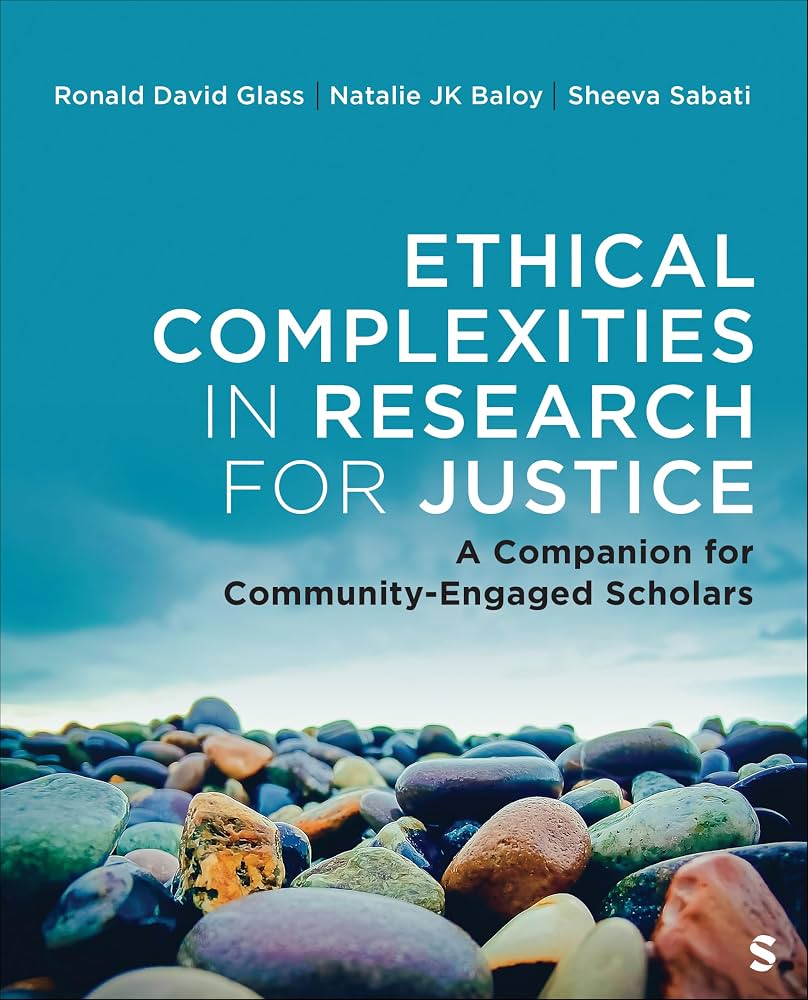
Ethical Complexities in Research for Justice: A Companion for Community-Engaged Scholars offers a transformative approach to research ethics that moves beyond checklists and compliance to support ethical discernment in complex, real-world research contexts. Grounded in a UC system-wide research initiative and written by three community-engaged scholars with roots at UC Santa Cruz, the book reframes ethics as an ongoing, relational praxis rather than a procedural requirement, with particular relevance for community-based, participatory, and justice-oriented scholarship that does not fit neatly within standard IRB frameworks. Through chapters organized around key ethical lenses—such as place and time, relationality, and knowing—and featuring ethics stories, reflective pauses, and dialogical cases, the book invites readers to grapple with ethical tensions across all stages of the research process. Designed as an interactive and pedagogical companion, it equips readers with the skills, dispositions, and reflexive capacities needed to unpack complex ethical dilemmas in their own research and to pursue socially meaningful scholarship with greater ethical attunement and accountability.
The event will highlight both this new resource and the national leadership role of UCSC in its development and in the field of community-engaged scholarship generally. Professors Glass, Baloy, and Sabati will offer a brief overview of the research project undergirding the book and its key contributions and resources, followed by a discussion and celebration of community-engaged scholarship at UCSC.
Featured Speakers:
Ronald David Glass – University of California, Santa Cruz
Ron is Professor Emeritus of Philosophy of Education at UC Santa Cruz (2005-2023) and former director of the University of California system-wide research program initiative, the Center for Collaborative Research for an Equitable California (2009-2015). His new book with Natalie JK Baloy and Sheeva Sabati investigates ethical issues raised by justice-oriented collaborative research methodologies (Sage Publications, 2027), and his other recent publications (e.g., with Ethan Chang, AERA Open, 2026) continues his career long focus on education as a practice of freedom, ideological (trans)formation, and creating just communities. He served as the 78th President of the Philosophy of Education Society (2022); his philosophy of praxis is rooted in his Civil Rights and anti-Viet Nam war and anti-nuclear weapons movement experiences, and his many years of working with organizations and aggrieved communities struggling for justice. He has been given multiple community and university honors for this work, including a Martin Luther King, Jr., Living the Dream Award from the City of Phoenix Human Relations Commission, a Paulo Freire Legacy Award from the American Educational Research Association (Paulo Freire SIG), and distinguished teaching awards from both the Stanford University School of Education and the University of California Santa Cruz Division of Social Sciences.

Natalie JK Baloy – Western Washington University
Dr. Natalie JK Baloy is an Associate Professor of Anthropology and Director of the Salish Sea Institute. Natalie brings over a decade of experience championing interdisciplinary collaboration, community-engaged research, and place-based teaching and learning. She lived on Orcas Island while completing her PhD in Cultural Anthropology at the University of British Columbia and now lives with her family in Bellingham. She co-founded the Salish Sea Studies program, collaborating with students, faculty, and community partners to create a curriculum that combines the humanities, natural sciences, social sciences, and Indigenous ways of knowing to cultivate a sense of place and responsibility to the future of the Salish Sea. Natalie’s work is informed by scholarship in critical Indigenous studies, settler colonial studies, and interdisciplinary collaborations toward transformation in context and community.
Sheeva Sabati, Ph.D. serves as an Associate Professor and Graduate Coordinator in the Doctorate in Educational Leadership and Policy Studies Program at California State University, Sacramento. Her approach to research, teaching and mentorship draw from the intersections of women of color and abolitionist feminisms, decolonial and settler colonial studies, as well as critical race and ethnic studies. As an interdisciplinary, critical foundations of education scholar, Sheeva has published on a variety of topics, most often in collaboration, that offer pathways to reimagine educational spaces as liberating sites of knowledge co-creation. This includes her work on anti-colonial research ethics (Qualitative Inquiry), abolition and teacher preparation (Teachers College Record), critical and abolitionist university studies (Philosophy of Education), movement based pedagogies (Educational Theory), water justice (Teaching in Higher Education; EPE: Nature and Space; Water Alternative), in addition to her work on community engaged research (Journal of Higher Education Outreach; Social Sciences; Urban Education). She finds critical hope through her collaborations with educational justice organizations, including the Latin American Philosophy of Education Society (LAPES), the Lessons in Liberation collective, and Families of Black Students United (FBSU). Before joining as faculty at Sacramento State, Sheeva served as a lecturer at UC Santa Cruz teaching courses in Education, CRES, Feminist Studies, and various undergraduate colleges, and served as the Director of the Community-Based Action Research and Advocacy (CARA) Program at Oakes College.
Location: UCSC Oakes Mural Room