• BME 280B Seminar: Artificial intelligence systems to advance engineered T cell immunotherapy designs

    Biomedical Sciences Biomedical Sciences Building Red Hill Road, Santa Cruz, CA

    Presenter: Zinaida Good, Assistant Professor of Medicine in the Division of Immunology and Rheumatology and the Division of Computational Medicine, Stanford University Description: T cell immunotherapies have reshaped the treatment landscape for hematologic malignancies and are rapidly extending to solid tumors, autoimmune diseases, and transplant tolerance. Yet durable benefit remains inconsistent, and toxicities remain clinically […]

  • Xu, Y. (CSE) – Right Place, Right Time: Accelerating Edge Computation on Modern Heterogeneous SoCs

    Engineering 2 Engineering 2 1156 High Street, Santa Cruz, CA
    Hybrid Event

    Modern edge computing increasingly relies on heterogeneous System-on-Chip (SoC) architectures. These chips tightly integrate general-purpose CPUs with various specialized accelerators, including GPUs, FPGAs, and AI accelerators, all under a shared memory architecture. Although these shared-memory SoCs enable more efficient communication and data sharing between different processing units, they are notoriously difficult to program and tune […]

  • Science in the Neighborhood: Transforming Pacific salmon recovery, from genes to ecosystems

    Science in the Neighborhood
    Coastal Biology Building 130 McAllister Way, Santa Cruz, CA

    For millennia, Pacific salmon have been integral to the health of coastal ecosystems and human communities from California to Alaska. Salmon are ecological and cultural keystone species, connecting marine and freshwater food webs and supporting thriving fisheries. Yet, wild salmon have declined precipitously due to a combination of factors including dams, harvest, hatcheries, water use—and now, climate change. This is part of the Science in the Neighborhood lecture series.

    Free
  • First Saturday Tour at the Arboretum

    First Saturday Tour at the Arboretum
    Arboretum 122 Arboretum Road, Santa Cruz, CA

    First Saturday Tours are a wonderful way to introduce yourself to the Arboretum or to deepen your knowledge of the Arboretum’s plant collections. Each tour is a little different depending on the time of year, the interests of the tour guide, and the people who join in. For example, you might learn about the birds […]

  • Hendawy, M. (CM) – Autonoming Child Online Safety in the Age of AI: From Control to Digital Co-Agency Across Cultures

    Virtual Event

    Children’s lives are now inextricably linked with AI-driven digital systems that shape learning, social interaction, and development. This has elevated child online safety to a central concern for families, policymakers, and educators. This makes Child online safety a wicked socio-technical problem, emerging from the complex interplay of social norms, platform incentives, cultural expectations, and rapidly […]

  • Statistics Seminar: Evaluating Predictive Algorithms Under Missing Data

    Presenter: Amanda Coston, Assistant Professor, University of California Berkeley Description: Performance evaluation plays a central role in decisions about whether and how predictive algorithms should be deployed in high-stakes settings. Yet, in many real-world domains, evaluation is fundamentally difficult: the data available for assessment are often biased, incomplete, or noisy, and the act of deploying […]

  • Robbins, A. (ECE) – How to train your organoid: goal-directed learning in biological neural networks

    Hybrid Event

    Artificial neural networks can now learn to play games, control robots, generate language, and solve complicated reasoning tasks, yet we still lack a clear understanding of how to directly guide learning in biological neural networks. We show that brain organoids can learn to solve a fundamental control task, balancing an inverted pendulum, through closed-loop electrophysiology. […]

  • ECE 290 Seminar: Dynamical Signatures: Harnessing the Hidden Language of In-Space Electric Propulsion

    Engineering 2 Engineering 2 1156 High Street, Santa Cruz, CA

    Presenter: Dr. Christine Greve, Research Engineer,  Edwards AFB Description: Low-thrust space electric propulsion systems offer long propulsion system lifetimes for satellite maintenance maneuvers. These thrusters operate by generating and accelerating plasmas, making the thrusters throttleable, propellant-efficient, and scalable from low-to-high power operations. This talk will focus on efforts to leverage the underlying time-dependent dynamics of […]

  • Harrison, D. (CS) – Multi-Level Control in Neural Dialogue Generation: Style, Semantics, and Selection through Over-Generation and Ranking

    End-to-end neural generation models have largely displaced the modular architectures that once gave dialogue system designers explicit control over what is said and how it is said. While these models produce fluent text, they collapse content planning, sentence planning, and surface realization into a single undifferentiated decoding step, sacrificing the controllable structure that earlier systems […]

  • AM Seminar: Solution Discovery in Fluids with High Precision Using Neural Networks

    Presenter: Ching-Yao Lai, Assistant Professor, Stanford University Description: I will discuss examples utilizing neural networks (NNs) to find solutions to partial differential equations (PDEs) that facilitate new discoveries. Despite being deemed universal function approximators, neural networks, in practice, struggle to fit functions with sufficient accuracy for rigorous analysis. Here, we developed multi-stage neural networks (Wang […]

  • Statistics Seminar: Evaluating Predictive Algorithms Under Missing Data

    Presenter: Amanda Coston, Assistant Professor, University of California Berkeley Description: Performance evaluation plays a central role in decisions about whether and how predictive algorithms should be deployed in high-stakes settings. Yet, in many real-world domains, evaluation is fundamentally difficult: the data available for assessment are often biased, incomplete, or noisy, and the act of deploying […]

  • Mashhadi, N. (CSE) – Compositional, Clinically Conditioned, and Confound-Aware Deep Learning for Alzheimer’s Disease Neuroimaging

    Virtual Event

    Alzheimer’s disease (AD) is a progressive neurodegenerative disorder and a leading cause of dementia. Neuroimaging and clinical biomarkers can reveal early disease changes, but building reliable machine learning models is difficult because data come from different scanners and sites, some modalities are missing, labeled cohorts are limited, and factors such as age and scanner/site effects […]

  • CSE Colloquium: Co-Active AI-Assisted Programming

    Engineering 2 Engineering 2 1156 High Street, Santa Cruz, CA

    Presenter: Nadia Polikarpova, UCSD Abstract: AI-assisted programming has rapidly moved from novelty to default. Today, most developers use AI coding tools, and increasingly rely on agentic systems capable of making multi-step design and implementation decisions with minimal human guidance. While these systems boost productivity, they also introduce new risks: developers may disengage from the reasoning behind […]

    Free
  • Yang, S. (CSE) – Beyond Image Editing: Building Generalized Image Customization Systems

    Virtual Event

    Current generative vision models struggle with image customization that requires multi-step reasoning or real-world knowledge. This proposal introduces generalized image customization, enabling systems to execute complex, inferential modifications rather than just simple edits. The research focuses on the foundational framework required for this generalization, specifically high-quality training data, scalable evaluation benchmarks, self-improving training paradigms that […]

  • What’s new in AI?

    Silicon Valley Campus 3175 Bowers Avenue, Santa Clara, CA, United States

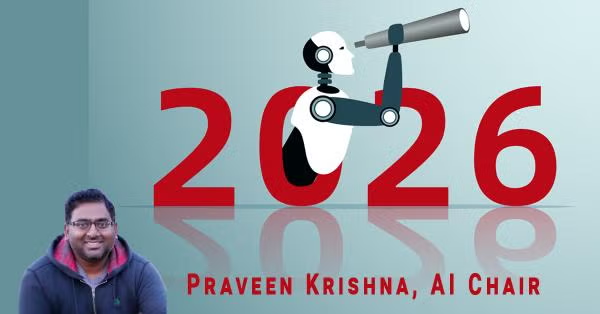
    Chat with the AI chair Lead innovation as a machine learning engineer Want to learn what’s new in AI? Join Praveen Krishna, chair of the Artificial Intelligence Application Development certificate program, in an informal discussion about the AI topic of the month and an open Q&A. You’ll get an insider’s look at what you need […]

  • BME 280B Seminar: Modulating Insulin Receptor Through New Ligands

    Physical Sciences Building Physical Sciences Building, Santa Cruz, CA

    Presenter: Danny Chou, Associate Professor of Pediatrics, Stanford University Description: Since its discovery in 1921, insulin has been at the forefront of scientific breakthroughs. From its amino acid sequencing to the revelation of its three‐dimensional structure, the progress in insulin research has spurred significant therapeutic breakthroughs. In recent years, protein engineering has introduced innovative chemical […]

  • [HSI Equity Talk] Beyond Invisibility: Reimagining Servingness to Support Undocumented Transfer Students

    Virtual Event

    Presenters: Valeria Alonso Blanco, Dr. Saskias Casanova, and Jesus Morales This interactive talk draws on a qualitative study conducted with undocumented Latinx transfer students at a California four-year HSI. Using focus groups and reflexive thematic analysis, we examined how these students perceive and experience institutional support, belonging, and barriers related to their intersectional identities. This […]

  • Your path to medical school starts here.

    Silicon Valley Campus 3175 Bowers Avenue, Santa Clara, CA, United States

    Are you considering medical school and seeking a clear, supportive path forward? Join the University of California, Santa Cruz, for a free online informational session to learn more about our Summer 2026 Premed Postbacc Cohort Programs. This session is designed for students and graduates who are serious about pursuing a career in health care and […]

  • Fan, Y. (CSE) – Building Human-Centered Multimodal AI Agents

    Virtual Event

    As multimodal artificial intelligence systems become increasingly embedded in everyday technology, there is a growing need to design human-centered AI agents that support and amplify human capabilities rather than replace them. This dissertation investigates how to build human-centered multimodal AI agents, framing human-centeredness as an agent-level objective that requires both accessible, assistive interaction and reliable, […]

  • Moghadam, M. (CE) – Constraint-Aware Scene Understanding and Trajectory Generation Using Deep Reinforcement Learning for Autonomous Vehicles

    Engineering 2 Engineering 2 1156 High Street, Santa Cruz, CA
    Hybrid Event

    Advanced driver-assistance systems (ADAS) are commonly organized as modular pipelines that transform raw sensor measurements into low-level actuation commands through perception, planning, and control. While learning-based methods have achieved state-of-the-art performance in perception and environment modeling, the planning layer remains a key bottleneck for reliable autonomy. Highway driving in particular requires long-horizon reasoning and socially […]