• Ramollari, H. (ECE) – An Optofluidic Spectrometer and Applications in Biosensing

    Hybrid Event

    Miniaturized spectrometers have the potential to replace bulky and expensive benchtop models. We have previously demonstrated a multimode interference (MMI) waveguide-based spectrometer that achieves high performance while minimizing its footprint. In this talk, the integration of the MMI spectrometer into an optofluidic device is proposed. This integration opens up applications such as the detection of […]


  • Torres, S. (ECE) – An Integrated Platform for Real-time Monitoring and Support of 3D Tissue Growth

    Virtual Event

    Organoids are three-dimensional tissue cultures that model real organs and serve as valuable tools for studying development, disease, and treatment response. Traditional methods, which rely on manual handling and incubators, limit consistency and real-time monitoring. To address these issues, we developed a modular microfluidic platform that integrates automated feeding, live fluorescence imaging, and environmental control […]

  • Chen, Q. (CSE) – New Approximation and Online Algorithms using Novel Combinatorial Structures

    Hybrid Event

    Most optimization problems face the challenge of computing an optimum solution requiring superpolynomial time. In particular, they are classified as NP-hard problems that have no polynomial-time algorithm to date. Instead, computer scientists turn to find an approximate solution and create numerous elegant algorithms. However, in the modern era, computational environments have changed drastically, and we […]

  • Littschwager, N. (CSE) – A Proposal for Characterizing Replicated Systems and Emulators

    Hybrid Event

    Simulation is a coinductive proof technique to assert the behavioral equivalence of computing systems that has seen fruitful application in distributed systems, concurrent process calculi, and programming languages, since the 1970’s. We have also utilized simulation in our prior work, where we formalized and proved a folklore claim that the state-based and operation-based approaches to […]

  • DeGrendele, C. (AM) – Learning-Augmented and Structure-Preserving Methods for Conservation Law Solvers

    Engineering 2 Engineering 2 1156 High Street, Santa Cruz, CA
    Hybrid Event

    In this work, we develop numerical methods for conservation laws that explore statistical, structure-preserving, and machine-learning-based approaches, each built on top of traditional numerical solvers. First, we develop a general Gaussian-process-based “recipe’’ for constructing high-order linear operators such as interpolation, reconstruction, and derivative approximations. Building on this recipe, we derive a kernel-agnostic convergence theory for […]

  • Garg, S. (CSE) – MAPPING ANNOTATIONS FROM NETLIST TO SOURCE CODE

    Engineering 2 Engineering 2 1156 High Street, Santa Cruz, CA
    Hybrid Event

    Hardware design flows have become increasingly complex as modern chips integrate billions of transistors and rely on aggressive synthesis optimizations to meet performance, area, and power targets. While these transformations improve circuit efficiency, they also erase the correspondence between gate-level netlists and their originating HDL source lines. The loss of traceability makes post-synthesis debugging, timing […]

  • Jamilan, S. (CSE) – Profile-guided Compiler Optimizations for Data Center Workloads

    Engineering 2 Engineering 2 1156 High Street, Santa Cruz, CA
    Hybrid Event

    Modern applications, such as data center workloads, have become increasingly complex. These applications primarily operate on massive datasets, which involve large memory footprints, irregular access patterns, and complex control and data flows. The processor-memory speed gap, combined with these complexities, can lead to unexpected performance inefficiencies in these applications, preventing them from achieving optimal performance. […]

  • de Priester, J. (ECE) – Hybrid Reinforcement Learning

    Jack Baskin Engineering Baskin Engineering 1156 High Street, Santa Cruz, CA
    Hybrid Event

    Reinforcement Learning (RL) is a machine learning paradigm that trains a decision maker, or policy, by learning from interaction with an environment. The power of RL lies in its ability to learn complex strategies without explicit human instruction, which can lead to better solutions that human designers overlook in domains ranging from robotics to scientific […]

  • Ferdous, N. (CSE) – SPECSIM : A Simulation Infrastructure Mitigating Transient Timing Attacks

    Engineering 2 Engineering 2 1156 High Street, Santa Cruz, CA
    Hybrid Event

       Transient execution attacks are serious security threats in modern-day processors. Out-of-order execution compels the processor to access data that should not be otherwise perceived. Leakage of that secret information creates a covert channel for the attacker for various types of transient and speculative attacks. Transient based execution attacks emanate when the secret information is leaked […]

  • Wang, Y. (CSE) – Toward Practical and Effective Large Language Model Unlearning

    Virtual Event

    The growing integration of Large Language Models (LLMs) into real-world applications has heightened concerns about their trustworthiness, as models may reveal private information, reproduce copyrighted content, propagate biases, or generate harmful instructions. These risks, alongside emerging privacy regulations, motivate the need for LLM unlearning, methods that remove the influence of specific data while preserving overall […]

  • Zhu, R. (ECE) – From Neuromorphic Principles to Efficient Neural Language Architectures

    Engineering 2 Engineering 2 1156 High Street, Santa Cruz, CA
    Hybrid Event

    While Large Language Models exhibit remarkable capabilities, their reliance on the standard Transformer architecture imposes prohibitive computational costs and quadratic memory complexity. To bridge the gap between biological efficiency and high-performance AI, we have established foundational work in linearizing attention and maximizing hardware utilization through architectures such as RWKV and MatMul-Free networks. Addressing the remaining […]

  • Singh, A. (ECE) – Quantum Key Distribution Using Entangled Pairs with Random Grouping

    Jack Baskin Engineering Baskin Engineering 1156 High Street, Santa Cruz, CA
    Hybrid Event

    Quantum Key Distribution (QKD) provides information-theoretic security for cryptographic key establishment, but existing protocols exhibit limited noise tolerance, restricting their applicability in practical quantum channels with finite resources. This work introduces a QKD protocol based on entanglement swapping that significantly enhances error tolerance and key generation rates. The protocol encodes six-bit classical symbols into six-qubit […]

  • Tran, L. (BMEB) – Polysome Shadowing: A Long-Read Sequencing Approach to Study Translation

    Biomedical Sciences Building 575 McLaughlin Drive

    Translation is a central and highly regulated step of gene expression, yet there are few quantitative, high-throughput tools to study translation. Existing methods such as sucrose gradients provide only bulk ribosome counts, while Ribo-Seq offers positional information in the genome but destroys long-range structure and transcript expression information. Because of these limitations, many fundamental questions […]

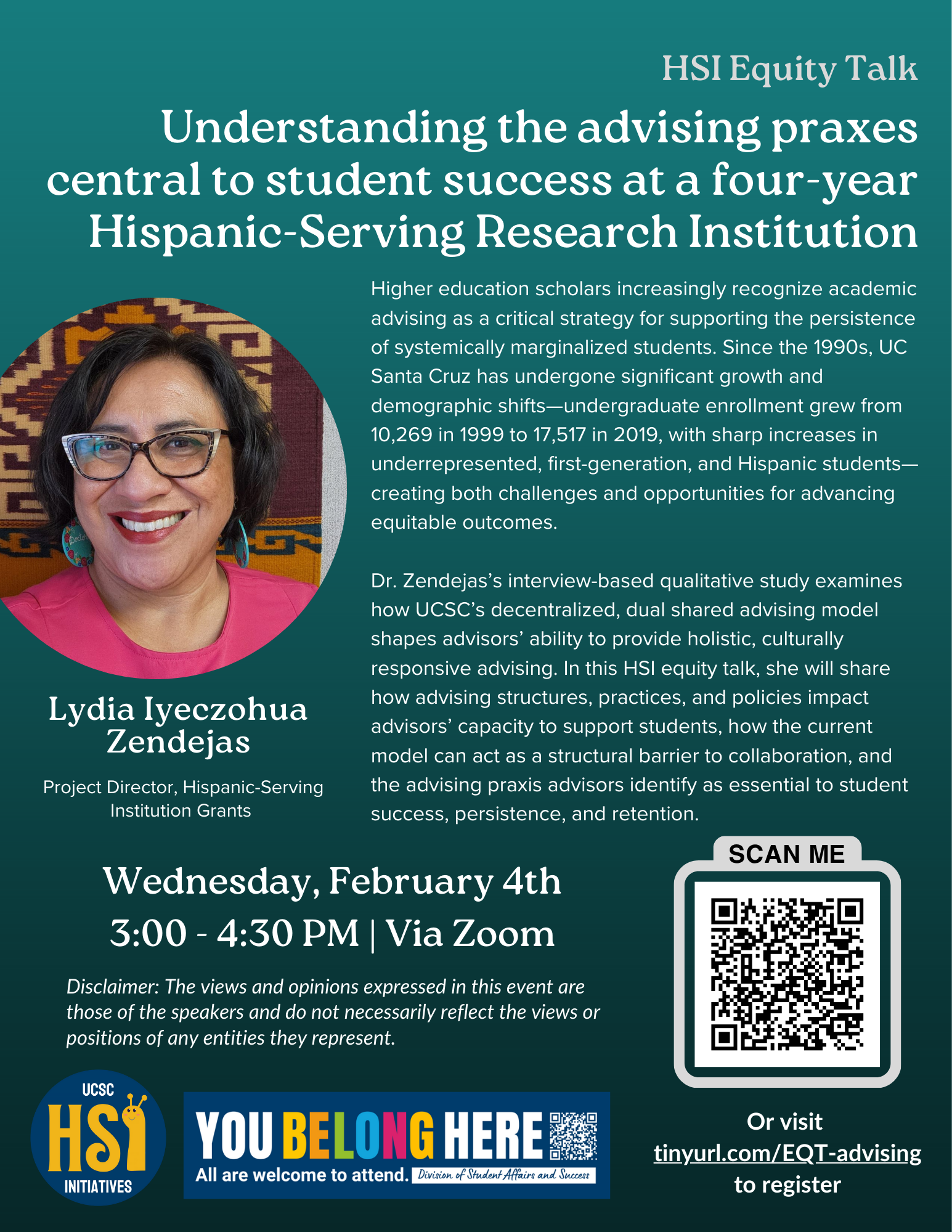
  • HSI Equity Talk

    Title: Understanding the advising praxes central to student success at a four-year Hispanic-Serving Research Institution Presenter: Dr. Lydia Iyeczohua Zendejas Location: Via Zoom (link provided via RSVP) Abstract: Higher education […]