• CSE Colloquium: A Journey from Programming Systems Research to AI Agents

    Engineering 2 Engineering 2 1156 High Street, Santa Cruz, CA

    Speaker: Koushik Sen, UC Berkeley and Google DeepMind Abstract: Coding has emerged as an important application area for large language models (LLMs), with a proliferation of code-specific models and their applications across various domains and tasks such as program repair, performance optimization, debugging, test generation, documentation, and security hardening. In this talk, I will describe […]

    Free
  • CSE Colloquium: Mitigating Data Scarcity via Simulation by Roozbeh Mottaghi

    Engineering 2 Engineering 2 1156 High Street, Santa Cruz, CA
    Hybrid Event

    Presenter: Roozbeh Mottaghi, University of Washington Abstract: Data has revolutionized progress across AI fields like natural language processing and computer vision. Yet, in robotics, data collection remains a significant challenge: […]

    Free
  • CSE Colloquium – Neurosymbolic AI: from research to industry

    Engineering 2 Engineering 2 1156 High Street, Santa Cruz, CA

    Presenter: Luis Lamb, Catholic Institute of Technology Abstract: Neurosymbolic AI brings together the statistical nature of machine learning with the formal reasoning capabilities of symbolic AI. It seeks to offer a balanced approach to contemporary AI technologies, by combining the ability to learn from data, with the capacity to reason upon knowledge acquired from an environment. […]

    Free
  • CSE Colloquium – Flux: Refinement Types for Verified Rust Systems

    Engineering 2 Engineering 2 1156 High Street, Santa Cruz, CA

    Presenter: Ranjit Jhala, UCSD Abstract: Rust has risen as a language of choice for new systems code — from OS kernels to hypervisors, firmware and run-times — as it is memory safe and provides the sort of abstractions needed for efficient low-level systems implementation. We present Flux, a refinement type checker for Rust that shows how […]

    Free
  • Torres, S. (ECE) – An Integrated Platform for Real-time Monitoring and Support of 3D Tissue Growth

    Virtual Event

    Organoids are three-dimensional tissue cultures that model real organs and serve as valuable tools for studying development, disease, and treatment response. Traditional methods, which rely on manual handling and incubators, limit consistency and real-time monitoring. To address these issues, we developed a modular microfluidic platform that integrates automated feeding, live fluorescence imaging, and environmental control […]

  • When Less is More: Applications of Type-Based Underapproximate Reasoning

    Engineering 2 Engineering 2 1156 High Street, Santa Cruz, CA

    Presenter: Suresh Jagganathan, Purdue University Abstract: Unlike program verifiers, symbolic execution and property-based testing tools underapproximate program behavior: they aim to report only real bugs (no false positives), at the cost of potentially missing some (false negatives). Recent work has sought to place such tools on a more formal footing, primarily through the development of incorrectness […]

    Free
  • CSE Colloquium: Making Systems Secure with Information Flow

    Engineering 2 Engineering 2 1156 High Street, Santa Cruz, CA

    Presenter: Andrew Myers, Cornell University Abstract: Modern civilization depends on complex, interconnected software systems that must safeguard trustworthy or private data. We have ever-growing mountains of code yet lack principled ways to build large systems that are secure. What is missing is a way to securely build these systems compositionally: module by module and layer […]

    Free
  • AM Seminar with Dr. Truong Vu

    Presenter: Dr. Truong Vu, IPAM and MSU Description: We present a framework for the gradient flow of sharp-interface surface energies that couple to embedded curvature active agents. We use a penalty method to develop families of locally incompressible gradient flows that couple interface stretching or compression to local flux of interfacial mass. We establish the […]


  • Kathleen Schmidt: Sequential Experimental Design for Materials Strength Model Calibration

    Presenter: Katie Schmidt, UQ & Optimization Group Leader, Lawrence Livermore National Laboratory Description: Due to the time and expense associated with physical experiments, there is significant interest in optimal selection of the conditions for future experiments. Selection based on reduction in parameter uncertainty provides a natural path forward. We consider this type of optimal sequential […]

  • AM Seminar: Science in the Age of Foundation Models

    Virtual Event

    Presenter: Dr. Danielle Robinson, AWS AI Description: In this talk, I will discuss the large impact of foundation models within the sciences with a particular focus on the importance of physical constraints and uncertainty quantification. First, I will detail our novel ProbConserv framework for enforcing hard constraints within black-box deep learning models. ProbConserv provides uncertainty […]

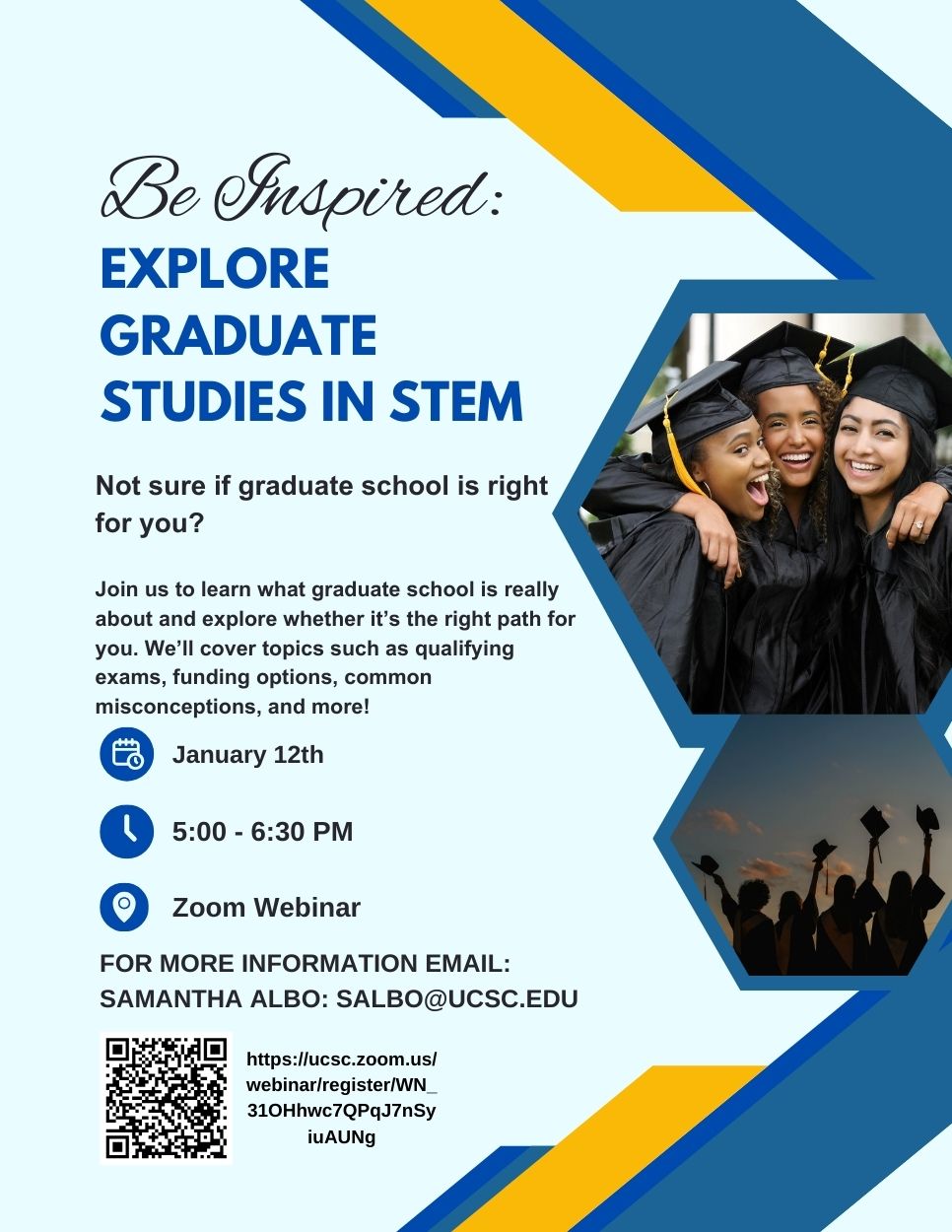
  • Be Inspired: Explore Graduate Studies in STEM

    Not sure if graduate school is right for you? Join us to learn what graduate school is really about and explore whether it’s the right path for you. We’ll cover topics such as qualifying exams, funding options, common misconceptions, and more! Click the link below to register for the event: https://ucsc.zoom.us/webinar/register/WN_31OHhwc7QPqJ7nSyiuAUNg

  • Statistics Seminar: Heterogeneous Statistical Transfer Learning

    Hybrid Event

    Presenter: Subhadeep Paul, Associate Professor, Ohio State University Description: In the first part of the talk, we consider the problem of Transfer Learning (TL) under heterogeneity from a source to a new target domain for high-dimensional regression with differing feature sets. Most homogeneous TL methods assume that target and source domains share the same feature […]

  • Statistics Seminar: Boosting Biomedical Imaging Analysis via Distributed Functional Regression and Synthetic Surrogates

    Virtual Event

    Presenter: Guannan Wang, Associate Professor, The College of William & Mary Description: Generative AI has emerged as a powerful tool for synthesizing biomedical images, offering new solutions to challenges such as data scarcity, privacy constraints, and modality imbalance. However, the reliable use of synthetic images in scientific analysis requires principled statistical frameworks that can assess […]

  • AM Seminar: Probing Forced Responses and Causality in Data-Driven Climate Emulators: Conceptual Limitations and the Role of Reduced-Order Models

    Virtual Event

    Presenter: Fabrizio Falasca, New York University Description: A central challenge in climate science and applied mathematics is developing data-driven models of multiscale systems that capture both stationary statistics and responses to external perturbations. Current neural climate emulators aim to resolve the atmosphere–ocean system in all its complexity but often struggle to reproduce forced responses, limiting […]

  • Statistics Seminar: Inferring Unobserved Trajectories from Multiple Temporal Snapshots

    Hybrid Event

    Presenter: Yunyi Shen, Ph.D. Candidate, Department of Electrical Engineering and Computer Science, Massachusetts Institute of Technology Description: Practitioners often aim to infer an unobserved population trajectory using sample snapshots at multiple time points. E.g. given single-cell sequencing data, scientists would like to learn how gene expression changes over a cell’s life cycle. But sequencing any […]

  • Statistics Seminar: Mathematical Foundations for Machine Learning from a Nonlinear Time Series Perspective

    Hybrid Event

    Presenter: Jiaqi Li, William H. Kruskal Instructor, University of Chicago Description:Modern machine learning (ML) algorithms achieve remarkable empirical success, yet providing rigorous statistical guarantees remains a major challenge, particularly in distributional theory and online inference methods. In this talk, we will introduce a novel framework to provide mathematical foundations for ML by bringing powerful tools […]