• Stand Out in Your Job Search: Tips from Veeva

    Come join Katie Groth, a University Recruiter at Veeva, as she shares valuable insights on how to make your resume, job applications, and interviews stand out. You’ll also have the chance to ask your own questions and get personalized advice on these topics.
    During the session, Katie will also provide insight into the Engineering Development Program, a unique program at Veeva designed to support new grads entering the software engineering space.

  • AM Seminar with Dr. Truong Vu

    Presenter: Dr. Truong Vu, IPAM and MSU Description: We present a framework for the gradient flow of sharp-interface surface energies that couple to embedded curvature active agents. We use a penalty method to develop families of locally incompressible gradient flows that couple interface stretching or compression to local flux of interfacial mass. We establish the […]

  • AM Seminar: Science in the Age of Foundation Models

    Virtual Event

    Presenter: Dr. Danielle Robinson, AWS AI Description: In this talk, I will discuss the large impact of foundation models within the sciences with a particular focus on the importance of physical constraints and uncertainty quantification. First, I will detail our novel ProbConserv framework for enforcing hard constraints within black-box deep learning models. ProbConserv provides uncertainty […]

  • Be Inspired: Explore Graduate Studies in STEM

    Not sure if graduate school is right for you? Join us to learn what graduate school is really about and explore whether it’s the right path for you. We’ll cover topics such as qualifying exams, funding options, common misconceptions, and more! Click the link below to register for the event: https://ucsc.zoom.us/webinar/register/WN_31OHhwc7QPqJ7nSyiuAUNg

  • Statistics Seminar: Boosting Biomedical Imaging Analysis via Distributed Functional Regression and Synthetic Surrogates

    Virtual Event

    Presenter: Guannan Wang, Associate Professor, The College of William & Mary Description: Generative AI has emerged as a powerful tool for synthesizing biomedical images, offering new solutions to challenges such as data scarcity, privacy constraints, and modality imbalance. However, the reliable use of synthetic images in scientific analysis requires principled statistical frameworks that can assess […]

  • AM Seminar: Probing Forced Responses and Causality in Data-Driven Climate Emulators: Conceptual Limitations and the Role of Reduced-Order Models

    Virtual Event

    Presenter: Fabrizio Falasca, New York University Description: A central challenge in climate science and applied mathematics is developing data-driven models of multiscale systems that capture both stationary statistics and responses to external perturbations. Current neural climate emulators aim to resolve the atmosphere–ocean system in all its complexity but often struggle to reproduce forced responses, limiting […]

  • AM Seminar: Are Graph Learning Methods Actually Learning?

    Presenter: Seshadhri Comandur, Professor of Computer Science, UCSC Description: There has been a lot of literature on graph machine learning over the past few years, and a bewildering array of new methods. This talk is based on a series of results making a provocative argument. Maybe many graph machine learning methods are not really that […]

  • Statistics Seminar: Statistical Inference for Multi-Modality Data in the AI Era

    Hybrid Event

    Presenter: Qi Xu, Postdoctoral Researcher, Department of Statistics & Data Science, Carnegie Mellon University Description: Multi-modality data are increasingly common across science medicine and technology, such as imaging, text, sensors, and genomics. These modalities are often high dimensional or unstructured and naturally exhibit blockwise (nonmonotone) missingness where different samples observe different subsets of modalities. Such […]

  • AM Seminar: Data Driven Modeling for Scientific Discovery and Digital Twins

    Presenter: Dongbin Xiu, Professor, Ohio State University Description:We present a data-driven modeling framework for scientific discovery, termed Flow Map Learning (FML). This framework enables the construction of accurate predictive models for complex systems that are not amenable to traditional modeling approaches. By leveraging data and the expressiveness of deep neural networks (DNNs), FML facilitates long-term […]

  • AM Seminar: Multiscale Modeling of Cellular Membranes and Oncogenic Proteins

    Presenter: Liam Stanton, Professor, San Jose State University Description: In this talk, I will present a multiscale model for cellular membranes, which is trained on molecular dynamics simulations. The model is constructed within the formalism of dynamic density functional theory and can be extended to include features such as the presence of proteins and membrane […]

  • Statistics Seminar: Rotated Mean-Field Variational Inference and Iterative Gaussianization

    Presenter: Sifan Liu, Assistant Professor, Department of Statistical Science, Duke University Description:Mean-field variational inference (MFVI) approximates a target distribution with a product distribution in the standard coordinate system, offering a scalable approach to Bayesian inference but often severely underestimating uncertainty due to neglected dependence. We show that MFVI can be greatly improved when performed along […]

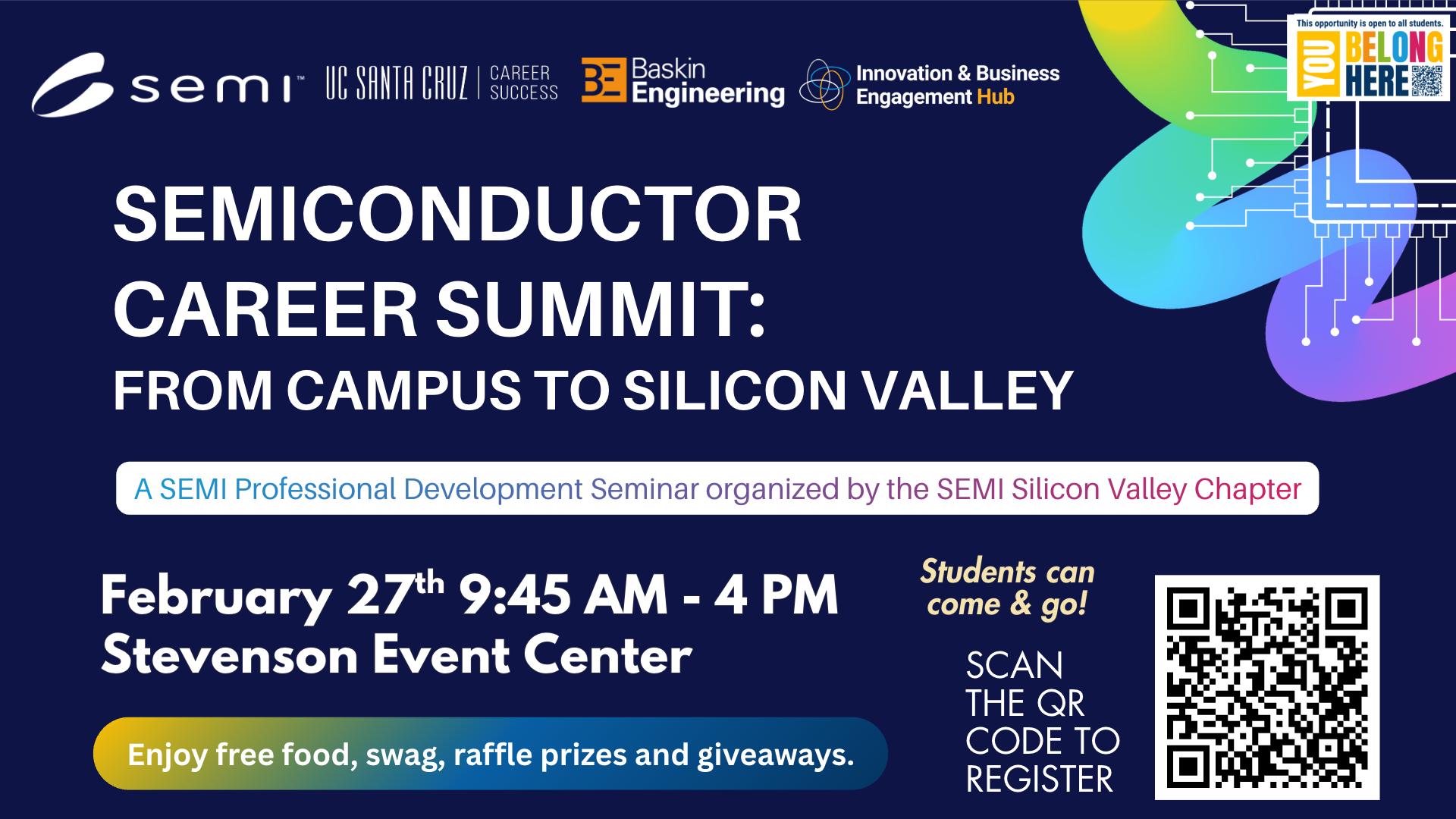
  • Semiconductor Career Summit – From Campus to Silicon Valley

    Stevenson Event Center Stevenson Service Road, Santa Cruz, CA

    A SEMI Professional Development Seminar organized by the SEMI Silicon Valley Chapter – Connecting College Students to the Semiconductor Industry. Learn about career opportunities in high tech and acquire valuable, practical information that will help you choose career directions and plan for your success.

  • Statistics Seminar: Decoding Phytoplankton Responses to a Changing Ocean

    Presenter: Francois Ribalet, Research Associate Professor, School of Oceanography, University of Washington Description: François Ribalet will present new observational technologies and computational approaches for studying phytoplankton responses to ocean warming. Using SeaFlow, a custom-built automated flow cytometer deployed on over 100 research cruises, his team has collected nearly 850 billion cell measurements across global oceans. […]

  • AM Seminar: The Evolving Landscape of AI for Science and Engineering: Bridging Simulation, Experiment, and Multi-scale Dynamics

    Presenter: Aditi Krishnapriyan, Assistant Professor, UC Berkeley Description: Recent advances in large-scale scientific datasets are creating new opportunities for machine learning (ML) methods to more effectively capture scientific phenomena with greater accuracy and reach. In this talk, I will discuss how these advances are both shifting ML design paradigms and enabling new scientific inquiries. This […]

  • AM Seminar: Solution Discovery in Fluids with High Precision Using Neural Networks

    Presenter: Ching-Yao Lai, Assistant Professor, Stanford University Description: I will discuss examples utilizing neural networks (NNs) to find solutions to partial differential equations (PDEs) that facilitate new discoveries. Despite being deemed universal function approximators, neural networks, in practice, struggle to fit functions with sufficient accuracy for rigorous analysis. Here, we developed multi-stage neural networks (Wang […]

  • AM Seminar: The Thinking Eye: AI That Sees, Reads, and Reasons in Medicine

    Presenter: Yuyin Zhou, Assistant Professor, UCSC Description: Medical AI is undergoing a profound transformation, evolving from simple pattern recognition to systems capable of complex clinical reasoning. This talk will chart this evolution across three dimensions: data, models, and evaluation. I will first highlight the shift from limited, unimodal datasets to massive multimodal resources. In particular, […]