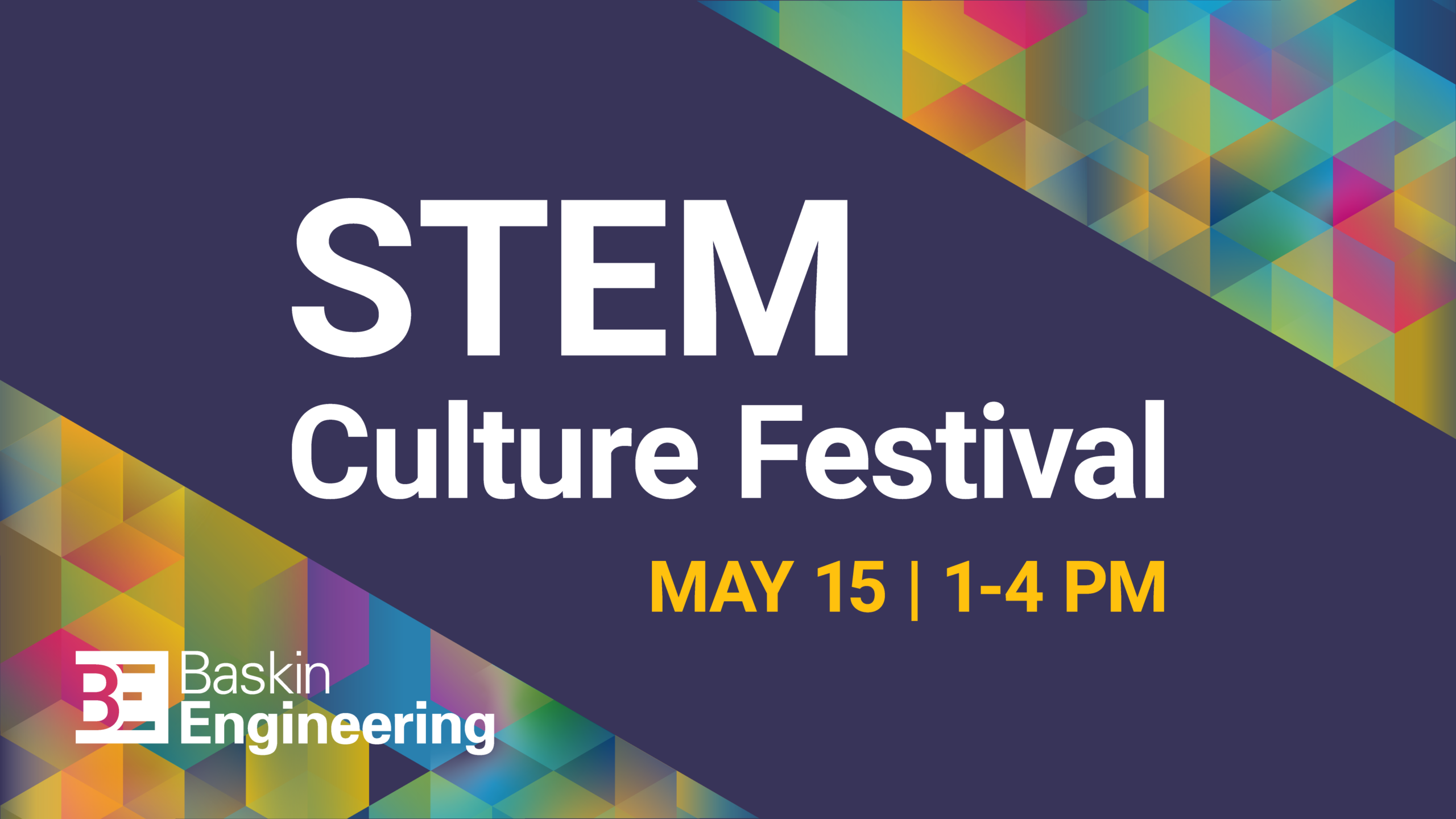
• Climate Week Tech Connect: Energy Solutions

    Jack Baskin Engineering Baskin Engineering 1156 High Street, Santa Cruz, CA

    Join Baskin Engineering to explore the frontier of power engineering, where the rapid rise of electrification and digital infrastructure is creating an unprecedented demand for next-generation talent and a critical opportunity for sustainability.  This networking event bridges the gap between the classroom and the field, offering students and faculty a front-row seat to the trends […]

  • Zheng, Z. (STATS) – Semi-Supervised Statistical Learning for Oceanographic Data

    Engineering 2 Engineering 2 1156 High Street, Santa Cruz, CA
    Hybrid Event

    Oceanographic data, generated by modern technologies that measure biological systems across time, space, and cell populations, are often rich, high-dimensional, and highly heterogeneous. Such data provide valuable opportunities to study subcellular organization, cellular heterogeneity, and dynamic biological processes in marine environments. However, because marine plankton systems remain relatively understudied and less well characterized than many […]

  • Quality First Coding Contest

    Engineering 2 Engineering 2 1156 High Street, Santa Cruz, CA

    This is a programming contest, but with a twist! Instead of scoring you based on your speed and solution accuracy, we score you based on your programming quality and solution accuracy. This means that instead of looking at how fast you can program a solution, we look at your number of compiles/runs instead.* The contestant that […]

    Free
  • Statistics Seminar: Active Learning for Fair and Stable Allocations

    Jack Baskin Engineering Baskin Engineering 1156 High Street, Santa Cruz, CA

    Presenter: Riddhiman Bhattacharya, Postdoc, UCSC Description: We propose an active learning approach for dynamic fair resource allocation problems. In contrast to prior work that assumes full feedback from all agents on their allocations, we focus on scenarios where feedback is available only from a carefully select subset of agents at each epoch of the online […]

  • Statistics Seminar: Advancing Statistical Rigor in Single-Cell and Spatial Omics Using In Silico Control Data

    Jack Baskin Engineering Baskin Engineering 1156 High Street, Santa Cruz, CA

    Presenter: Guan’ao Yan, Assistant Professor, Michigan State University Description: Single-cell and spatial transcriptomics technologies now let us map cellular diversity and tissue organization at high resolution, but the computational methods built to analyze these data are difficult to evaluate in a rigorous, reproducible way. Two key barriers are the lack of realistic synthetic data with […]

  • Wang, Q. (STAT) – Modern Statistical Methods for Modeling Spatial and Temporal Processes

    Jack Baskin Engineering Baskin Engineering 1156 High Street, Santa Cruz, CA
    Hybrid Event

    Modern scientific studies increasingly rely on complex datasets exhibiting spatial and temporal dependence, particularly in social, environmental, and climate applications. This dissertation develops statistical models and computational methods for analyzing such data, with an emphasis on capturing dependence structures, nonlinear dynamics, and uncertainty quantification. A spatial deep learning framework is developed to extend classical geostatistical […]

  • Statistics Seminar: Learning under Constraints and Extremes: Methods and Applications in Energy Systems

    Jack Baskin Engineering Baskin Engineering 1156 High Street, Santa Cruz, CA

    Presenter: Yu Zhang, Associate Professor, ECE Department of UC, Santa Cruz Description: Modern cyber-physical systems present statistical learning problems that deviate significantly from standard i.i.d. supervised settings. In particular, two challenges frequently arise: (i) learning under hard structural constraints, and (ii) learning under severe distributional imbalance and rare events. In this talk, I present two […]

  • Statistics Seminar: Unifying Regression-Based and Design-Based Causal Inference in Time-Series Experiments and Crossover Experiments

    Jack Baskin Engineering Baskin Engineering 1156 High Street, Santa Cruz, CA

    Presenter: Peng Ding, Associate Professor, UC Berkeley Description: I will present some recent results on unifying regression-based and design-based causal inference in time-series experiments and crossover experiments. Part I: Time-series experiments, also called switchback experiments or N-of-1 trials, play increasingly important roles in modern applications in medical and industrial areas. Under the potential outcomes framework, […]

  • Annual BE Student Project Showcase

    The annual BE Student Project Showcase celebrates the innovative work and accomplishments of undergraduate engineers in capstone courses and research pathways.

  • Statistics Seminar: From Random Walks to Planning-Ready World Models: A Normative Model of Place Cells

    Jack Baskin Engineering Baskin Engineering 1156 High Street, Santa Cruz, CA

    Presenter: Deqian Kong, PhD student, UCLA Description: How does the hippocampus turn experience into a cognitive map that is not just a passive record of space but a representation ready for planning? In this talk, I will present a normative model in which place cells emerge as a non-negative population embedding whose inner products approximate […]

  • Le, A. (STAT) – Bayesian Nonparametric Analysis of Densities for Replicated Point Patterns

    Virtual Event

    Many scientific applications produce repeated point pattern realizations across subjects, regions, or time. While such point patterns exhibit individual variation, we assume they arise from related point processes that share a common distributional structure. This dissertation develops a Bayesian nonparametric modeling framework built around an interpretable baseline. We work with Poisson processes, such that the […]

  • Shen, J. (STAT) – Bayesian Modeling and Uncertainty Quantification for Verbal Autopsy Data

    Virtual Event

    Verbal autopsy (VA) is a well developed tool to collect information describing deaths outside of hospitals by conducting surveys to the relatives and caregivers of the deceased person. It is routinely-implemented in low and middle income countries, where it often lacks sufficient resources to conduct the autopsy. The main task is to estimate both individual […]

  • Zhang, X. (STAT) – Predictive Generalized Variational Inference for Spatial Gaussian Process Model

    Virtual Event

    Spatially dependent data are common in environmental and climate studies, where Gaussian process models are used for prediction and uncertainty quantification. Learning their covariance structure involves both statistical and computational challenges. Likelihood-based inference may be sensitive to covariance misspecification, while repeated evaluation of prediction-oriented criteria can be computationally demanding. To study these issues, we develop […]

  • Chen, Y. (STAT) – Flexible Bayesian Models for High-Dimensional and Longitudinal Discrete Data in Microbiome Studies

    Virtual Event

    Multivariate dependent discrete data routinely arise in microbiome studies. Analyzing these data presents interesting statistical challenges, such as high dimensionality, excess zeros, large heterogeneity across samples, and temporal dependence in longitudinal studies. Drawing inferences about objects of primary scientific interest—such as temporal trajectories of microbial abundance, microbial interactions, clusters of microbes similarly associated with environmental […]

  • Statistics Seminar: Vecchia Approximated Bayesian Heteroskedastic Gaussian Processes

    Jack Baskin Engineering Baskin Engineering 1156 High Street, Santa Cruz, CA

    Presenter: Parul Patil, Postdoctoral Researcher, UC Santa Cruz Description: Many computer simulations are stochastic and exhibit input dependent noise. In such situations, heteroskedastic Gaussian processes (hetGPs) make ideal surrogates as they estimate a latent, non-constant variance. However, existing hetGP implementations are unable to deal with large simulation campaigns and use point-estimates for all unknown quantities, […]