
- This event has passed.
Statistics Seminar: From Random Walks to Planning-Ready World Models: A Normative Model of Place Cells
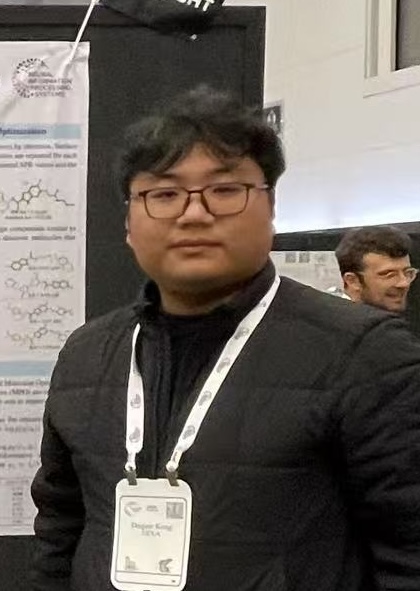
Presenter: Deqian Kong, PhD student, UCLA
Description: How does the hippocampus turn experience into a cognitive map that is not just a passive record of space but a representation ready for planning? In this talk, I will present a normative model in which place cells emerge as a non-negative population embedding whose inner products approximate the multi-step random walk transition kernel across a discrete set of time scales. From this single construction, a great deal follows. First, the representation reproduces signature biological phenomena: multi-scale place fields that mirror the hippocampal dorsoventral gradient, theta phase precession as an angular sweep in representational geometry (angle–phase duality), and contextual remapping. Second, and more consequentially, the resulting cognitive map is proximity-preserving — Euclidean distance in embedding space monotonically tracks graph distance in the environment — so path planning reduces to following the gradient of the learned embedding, with no value iteration, no explicit map reconstruction, and no learned optimal policy. The underlying one-step transition is just random exploration; optimal trajectories arise from inference on the multi-scale kernel. I will argue that this turns place cells from a phenomenological model of space into a planning-centric world model: a single likelihood objective trains the kernel, and planning, goal-reaching, and re-routing under detours or shortcuts all reduce to gradient queries against the learned geometry. I will close by briefly contrasting this proposal with prevailing world models in machine learning — Vision–Language–Action policies, model-predictive control, and latent-dynamics models— to highlight what is distinctive about a planning-ready cognitive map built from random exploration alone.
Bio: Deqian Kong is a PhD candidate in Statistics and Data Science at UCLA, advised by Prof. Ying Nian Wu, and a student researcher at Google DeepMind. His research develops generative models — latent-variable models, energy-based models, and language models — with applications in reasoning, robotic planning, drug discovery, and representational models of spatial navigation. His work has appeared at NeurIPS, ICML, ICLR, ICCV, UAI, and CoRL, with spotlight presentations at NeurIPS 2024 and CoRL 2025. He has previously held research positions at Lambda, Amazon, and BioMap Research.
Hosted by: Statistics Department