• Laffan, N. (CM) – Digital Memory Tools and Their Impact On Collective Remembering

    Virtual Event

    Today, both individual and collective memories are increasingly mediated by digital platforms. Both are fundamentally enmeshed in platform ecosystems that orient around commercial imperatives very much at odds with community cohesion. The digital archive where our mediated memories are stored does not merely store information but actively inscribes it, often privileging narratives aligned with commercial […]
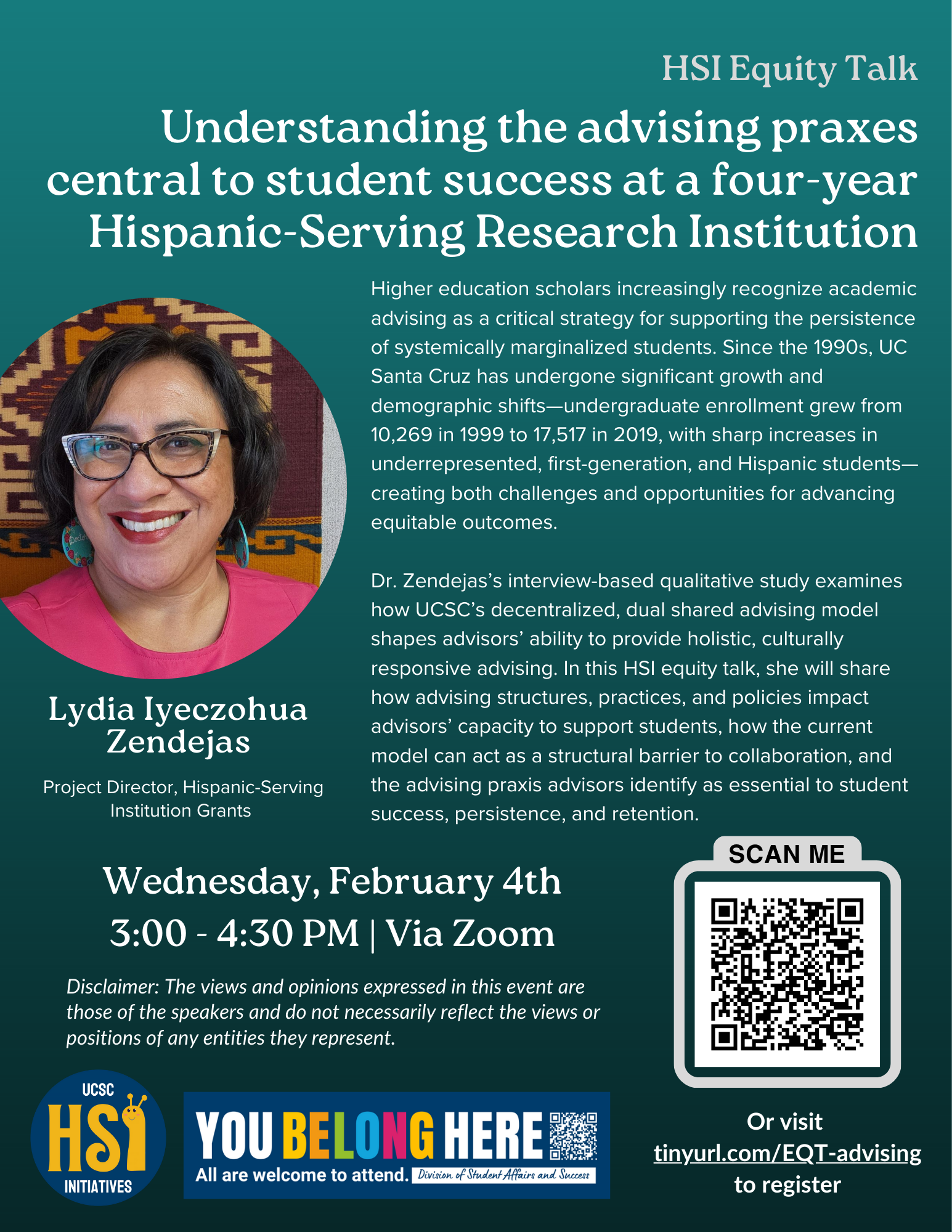

  • HSI Equity Talk

    Title: Understanding the advising praxes central to student success at a four-year Hispanic-Serving Research Institution Presenter: Dr. Lydia Iyeczohua Zendejas Location: Via Zoom (link provided via RSVP) Abstract: Higher education scholars increasingly recognize academic advising as a critical strategy for supporting the persistence of systemically marginalized students. Since the 1990s, UC Santa Cruz has undergone […]

  • Sharma, R. (CSE) – Automatically Evolving GPU Libraries for Performance Portable AI Kernels

    Engineering 2 Engineering 2 1156 High Street, Santa Cruz, CA
    Hybrid Event

    GPUs are the workhorses of modern AI, widely deployed and developed by many vendors including Apple, Qualcomm, Intel, AMD, and NVIDIA. While these GPUs all offer high compute potential, programming them effectively is difficult because they differ in performance-critical features like SIMT width, cache capacity, and memory bandwidth, demanding different optimization strategies. Tunable kernels address […]

  • Sambamurthy, A. (AM) – Lazy Diffusion: Resolving Spectral Collapse in Generative Models for Turbulence

    Engineering 2 Engineering 2 1156 High Street, Santa Cruz, CA
    Hybrid Event

    Diffusion-based generative models offer a principled framework for probabilistic forecasting, but we show they suffer from a fundamental spectral collapse when applied to turbulent flows. A Fourier-space analysis of the forward SDE reveals that the mode-wise signal-to-noise ratio decays monotonically in wavenumber for power-law spectra, rendering high-wavenumber content indistinguishable from noise. We reinterpret the noise […]

  • Liu, C. (CSE) – Enabling LLM Unlearning at Inference Time by Decomposing Detection and Intervention

    Virtual Event

    Machine unlearning addresses the “right to be forgotten” under GDPR and enables privacy, copyright, and safety compliance in large language models. Training-based unlearning can remove targeted behavior on benchmarks, but it scales poorly, can degrade utility, and can fail under adversarial prompting that recovers supposedly forgotten content. This prospectus proposes inference-time behavioral unlearning: rather than […]

  • Shields, S. (CM) – Procedural, Player-Centric Game Balancing

    Merrill College College Office, Santa Cruz, CA
    Hybrid Event

    Game balance is a term widely used among players, researchers, and designers of games. It is a concept that feels vitally important to how we make and play games – but when we try to define it or implement it, we seldom get the same definition twice. Balance appears differently to whoever is judging it, […]

  • Xu, Y. (CSE) – Right Place, Right Time: Accelerating Edge Computation on Modern Heterogeneous SoCs

    Engineering 2 Engineering 2 1156 High Street, Santa Cruz, CA
    Hybrid Event

    Modern edge computing increasingly relies on heterogeneous System-on-Chip (SoC) architectures. These chips tightly integrate general-purpose CPUs with various specialized accelerators, including GPUs, FPGAs, and AI accelerators, all under a shared memory architecture. Although these shared-memory SoCs enable more efficient communication and data sharing between different processing units, they are notoriously difficult to program and tune […]

  • Harrison, D. (CS) – Multi-Level Control in Neural Dialogue Generation: Style, Semantics, and Selection through Over-Generation and Ranking

    End-to-end neural generation models have largely displaced the modular architectures that once gave dialogue system designers explicit control over what is said and how it is said. While these models produce fluent text, they collapse content planning, sentence planning, and surface realization into a single undifferentiated decoding step, sacrificing the controllable structure that earlier systems […]

  • Yang, S. (CSE) – Beyond Image Editing: Building Generalized Image Customization Systems

    Virtual Event

    Current generative vision models struggle with image customization that requires multi-step reasoning or real-world knowledge. This proposal introduces generalized image customization, enabling systems to execute complex, inferential modifications rather than just simple edits. The research focuses on the foundational framework required for this generalization, specifically high-quality training data, scalable evaluation benchmarks, self-improving training paradigms that […]

  • Fan, Y. (CSE) – Building Human-Centered Multimodal AI Agents

    Virtual Event

    As multimodal artificial intelligence systems become increasingly embedded in everyday technology, there is a growing need to design human-centered AI agents that support and amplify human capabilities rather than replace them. This dissertation investigates how to build human-centered multimodal AI agents, framing human-centeredness as an agent-level objective that requires both accessible, assistive interaction and reliable, […]

  • Moghadam, M. (CE) – Constraint-Aware Scene Understanding and Trajectory Generation Using Deep Reinforcement Learning for Autonomous Vehicles

    Engineering 2 Engineering 2 1156 High Street, Santa Cruz, CA
    Hybrid Event

    Advanced driver-assistance systems (ADAS) are commonly organized as modular pipelines that transform raw sensor measurements into low-level actuation commands through perception, planning, and control. While learning-based methods have achieved state-of-the-art performance in perception and environment modeling, the planning layer remains a key bottleneck for reliable autonomy. Highway driving in particular requires long-horizon reasoning and socially […]

  • Wang, H. (CSE) – Accelerating RTL Simulation with Specialized Graph Partitioners

    Jack Baskin Engineering Baskin Engineering 1156 High Street, Santa Cruz, CA

    Register transfer level (RTL) simulation is an invaluable tool for developing, debugging, verifying, and validating hardware designs. However, the performance of RTL simulation has long been a limiting factor in industry. Despite the inherent parallelism of hardware, current RTL simulators have not achieved practical performance gains due to fundamental challenges in communication, synchronization, memory bandwidth, […]