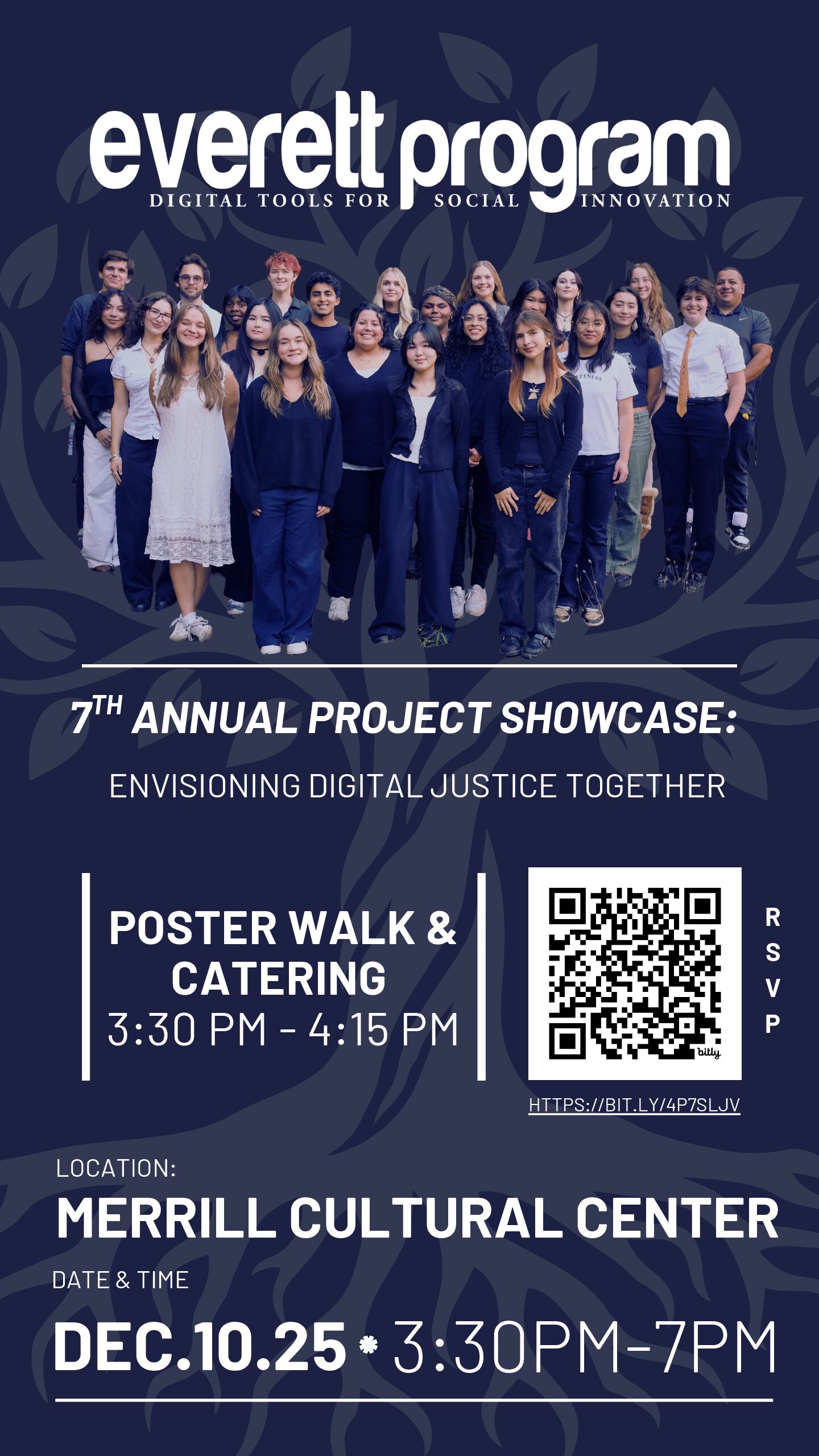
• The Everett Program Presents: Envisioning Digital Justice Together | 7th Annual Project Showcase

    Merrill Cultural Center 200 McLaughlin Dr, Santa Cruz, CA
    Hybrid Event

    The Everett Program Presents: Envisioning Digital Justice Together | 7th Annual Project Showcase
    This showcase aims to highlight the incredible work of our students, who have completed a year-long practicum conceptualizing and using digital technology to work with nonprofit organizations on social justice issues from climate justice to the racist impacts of the carceral state.
    This year, Showcase is an event in which the audience can not only come together to support these wonderful students and their work, but to envision a range of digital futures together.

    All are welcome! RSVP with the QR Code found on the poster 🙂

    Free
  • CM Seminar – “How Technology-Mediated Food Interactions Support Family Connection and Routine Reconstruction”

    Silicon Valley Campus 3175 Bowers Avenue, Santa Clara, CA, United States

    Presented by: Aswati Panicker Description: “In this talk, I draw on work in human-food interaction (HFI) to examine how food can serve as a rich interaction medium for connection and routine reconstruction in long-distance families. I highlight insights from three of my studies that explore this question across different technological forms. First, I discuss how families […]

  • AM Seminar with Dr. Truong Vu

    Presenter: Dr. Truong Vu, IPAM and MSU Description: We present a framework for the gradient flow of sharp-interface surface energies that couple to embedded curvature active agents. We use a penalty method to develop families of locally incompressible gradient flows that couple interface stretching or compression to local flux of interfacial mass. We establish the […]

  • BME 280B Seminar: Nature’s Miniature Masterpieces – Nanobodies as Small but Mighty Antibodies for the next Pandemic

    Physical Sciences Building Physical Sciences Building, Santa Cruz, CA

    Presenter: Katja Hanack, Founder and CEO, New/Era/Mabs Description: Nanobodies combine remarkable simplicity with surprising power. Their small size allows them to reach targets that remain inaccessible to conventional antibodies, while maintaining high specificity and stability. Their compact architecture allows them to access targets that conventional antibodies cannot reach, yet they preserve the specificity and power […]

  • Kathleen Schmidt: Sequential Experimental Design for Materials Strength Model Calibration

    Presenter: Katie Schmidt, UQ & Optimization Group Leader, Lawrence Livermore National Laboratory Description: Due to the time and expense associated with physical experiments, there is significant interest in optimal selection of the conditions for future experiments. Selection based on reduction in parameter uncertainty provides a natural path forward. We consider this type of optimal sequential […]

  • AM Seminar: Science in the Age of Foundation Models

    Virtual Event

    Presenter: Dr. Danielle Robinson, AWS AI Description: In this talk, I will discuss the large impact of foundation models within the sciences with a particular focus on the importance of physical constraints and uncertainty quantification. First, I will detail our novel ProbConserv framework for enforcing hard constraints within black-box deep learning models. ProbConserv provides uncertainty […]

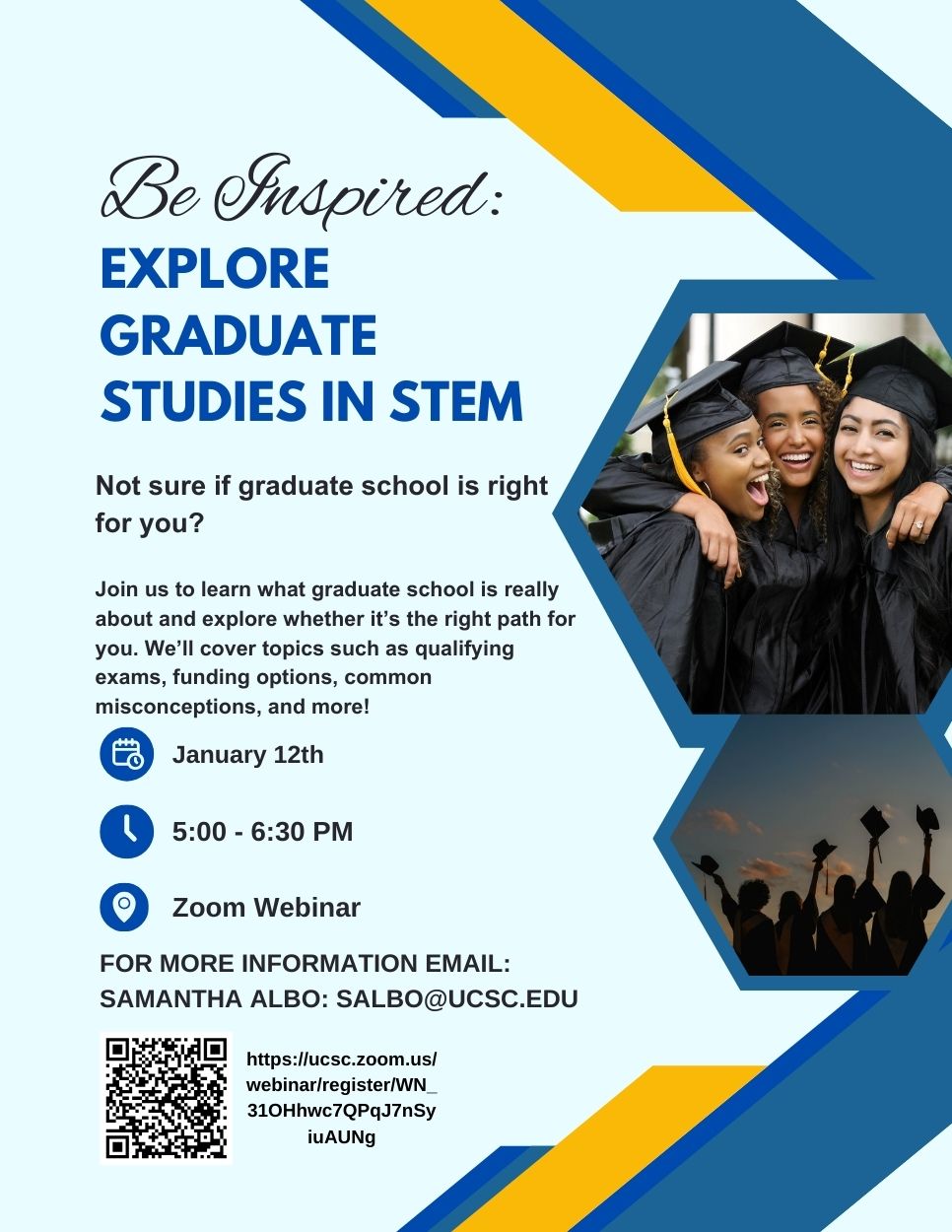
  • Be Inspired: Explore Graduate Studies in STEM

    Not sure if graduate school is right for you? Join us to learn what graduate school is really about and explore whether it’s the right path for you. We’ll cover topics such as qualifying exams, funding options, common misconceptions, and more! Click the link below to register for the event: https://ucsc.zoom.us/webinar/register/WN_31OHhwc7QPqJ7nSyiuAUNg

  • CSE Colloquium – Constraining Chaos: Toward Faithful and Semantic Decoding in Language Models

    Engineering 2 Engineering 2 1156 High Street, Santa Cruz, CA

    Presenter: Loris D’Antoni, UC San Diego Abstract: Language models excel at producing fluent text, but in domains like code and math, fluency isn’t enough — outputs must obey strict syntactic and semantic rules. A new wave of research is rethinking decoding itself: not as a process of sampling words, but as a negotiation between probability, structure, and […]

    Free
  • BME Seminar: Rotation Talks

    Physical Sciences Building Physical Sciences Building, Santa Cruz, CA

    Presenter: Grad Students Description: Rotation Talks Bio: N/A Hosted by: Professor Rebecca DuBois, BME Department

  • Statistics Seminar: Heterogeneous Statistical Transfer Learning

    Hybrid Event

    Presenter: Subhadeep Paul, Associate Professor, Ohio State University Description: In the first part of the talk, we consider the problem of Transfer Learning (TL) under heterogeneity from a source to a new target domain for high-dimensional regression with differing feature sets. Most homogeneous TL methods assume that target and source domains share the same feature […]

  • ECE Seminar: Tactile sensing: At the boundary between mechanical and computational intelligence in robotic grippers

    Engineering 2 Engineering 2 1156 High Street, Santa Cruz, CA

    Presenter: Dr. Hannah Stuart, Associate Professor in the Department of Mechanical Engineering, University of California at Berkeley Description: Robot grippers typically include mechanical intelligence (e.g., underactuation, compliance) or computational intelligence (e.g., fully actuated with a wide array of sensors). Next generation grippers and hands will require both intelligences to work in concert across applications with […]

  • Statistics Seminar: Boosting Biomedical Imaging Analysis via Distributed Functional Regression and Synthetic Surrogates

    Virtual Event

    Presenter: Guannan Wang, Associate Professor, The College of William & Mary Description: Generative AI has emerged as a powerful tool for synthesizing biomedical images, offering new solutions to challenges such as data scarcity, privacy constraints, and modality imbalance. However, the reliable use of synthetic images in scientific analysis requires principled statistical frameworks that can assess […]

  • CM Seminar – “Revealing Hidden Stories: Co-Designing the Thámien Ohlone Augmented Reality Tour”

    Engineering 2 Engineering 2 1156 High Street, Santa Cruz, CA

    Presented by: Kai Lukoff Description: The Santa Clara University campus is adorned with symbols and monuments, including a Spanish Mission Church, that highlight its Catholic heritage. However, the presence and history of the Ohlone Native Americans, who have inhabited this land for thousands of years and continue to live in the region, receive little to […]

  • AM Seminar: Probing Forced Responses and Causality in Data-Driven Climate Emulators: Conceptual Limitations and the Role of Reduced-Order Models

    Virtual Event

    Presenter: Fabrizio Falasca, New York University Description: A central challenge in climate science and applied mathematics is developing data-driven models of multiscale systems that capture both stationary statistics and responses to external perturbations. Current neural climate emulators aim to resolve the atmosphere–ocean system in all its complexity but often struggle to reproduce forced responses, limiting […]

  • CSE Colloquium – Towards Relational Foundation Models: Zero-Shot Forecasting over Relational Databases

    Engineering 2 Engineering 2 1156 High Street, Santa Cruz, CA

    Presenter: Charilaos I. Kanatsoulis, Stanford University Abstract: Foundation models have transformed unstructured domains such as language and vision, yet relational datasets, where most enterprise knowledge lives, still rely on brittle, task-specific ML pipelines. I will begin by introducing Relational Deep Learning (RDL), a general framework for learning directly from heterogeneous multi-table data, capturing structure across entities, attributes, […]

    Free
  • Statistics Seminar: Inferring Unobserved Trajectories from Multiple Temporal Snapshots

    Hybrid Event

    Presenter: Yunyi Shen, Ph.D. Candidate, Department of Electrical Engineering and Computer Science, Massachusetts Institute of Technology Description: Practitioners often aim to infer an unobserved population trajectory using sample snapshots at multiple time points. E.g. given single-cell sequencing data, scientists would like to learn how gene expression changes over a cell’s life cycle. But sequencing any […]