• Statistics Seminar: Evaluating Predictive Algorithms Under Missing Data

    Presenter: Amanda Coston, Assistant Professor, University of California Berkeley Description: Performance evaluation plays a central role in decisions about whether and how predictive algorithms should be deployed in high-stakes settings. Yet, in many real-world domains, evaluation is fundamentally difficult: the data available for assessment are often biased, incomplete, or noisy, and the act of deploying […]

  • ECE 290 Seminar: Dynamical Signatures: Harnessing the Hidden Language of In-Space Electric Propulsion

    Engineering 2 Engineering 2 1156 High Street, Santa Cruz, CA

    Presenter: Dr. Christine Greve, Research Engineer,  Edwards AFB Description: Low-thrust space electric propulsion systems offer long propulsion system lifetimes for satellite maintenance maneuvers. These thrusters operate by generating and accelerating plasmas, making the thrusters throttleable, propellant-efficient, and scalable from low-to-high power operations. This talk will focus on efforts to leverage the underlying time-dependent dynamics of […]

  • AM Seminar: Solution Discovery in Fluids with High Precision Using Neural Networks

    Presenter: Ching-Yao Lai, Assistant Professor, Stanford University Description: I will discuss examples utilizing neural networks (NNs) to find solutions to partial differential equations (PDEs) that facilitate new discoveries. Despite being deemed universal function approximators, neural networks, in practice, struggle to fit functions with sufficient accuracy for rigorous analysis. Here, we developed multi-stage neural networks (Wang […]

  • Statistics Seminar: Evaluating Predictive Algorithms Under Missing Data

    Presenter: Amanda Coston, Assistant Professor, University of California Berkeley Description: Performance evaluation plays a central role in decisions about whether and how predictive algorithms should be deployed in high-stakes settings. Yet, in many real-world domains, evaluation is fundamentally difficult: the data available for assessment are often biased, incomplete, or noisy, and the act of deploying […]

  • CSE Colloquium: Co-Active AI-Assisted Programming

    Engineering 2 Engineering 2 1156 High Street, Santa Cruz, CA

    Presenter: Nadia Polikarpova, UCSD Abstract: AI-assisted programming has rapidly moved from novelty to default. Today, most developers use AI coding tools, and increasingly rely on agentic systems capable of making multi-step design and implementation decisions with minimal human guidance. While these systems boost productivity, they also introduce new risks: developers may disengage from the reasoning behind […]

    Free
  • BME 280B Seminar: Modulating Insulin Receptor Through New Ligands

    Physical Sciences Building Physical Sciences Building, Santa Cruz, CA

    Presenter: Danny Chou, Associate Professor of Pediatrics, Stanford University Description: Since its discovery in 1921, insulin has been at the forefront of scientific breakthroughs. From its amino acid sequencing to the revelation of its three‐dimensional structure, the progress in insulin research has spurred significant therapeutic breakthroughs. In recent years, protein engineering has introduced innovative chemical […]

  • Restoring Connections: Indigenous Environmental Governance and Eco-Cultural Revitalization along the Central California Coast

    Alexii Sigona from UC Davis In Person Location: ISB 221 Zoom Link This presentation examines how California Tribal nations enact their place-based responsibilities as stewards of their ancestral lands and waters. Using ethnographic research with the Amah Mutsun Tribal Band (AMTB) of central coastal California, I trace the processes of Tribal eco-cultural revitalization enacted through […]

  • AM Seminar: Flexible Filaments and Swimming Cups: Just Go with the Flow

    Presenter: Lisa Fauci, Professor, Tulane University Description: The motion of waving or rotating filaments in a fluid environment is a common element in many biological and engineered systems. Examples at the microscale include chains of diatoms moving in the ocean, flagella of individual cells comprising multicellular colonies, as well as engineered nanorobots designed to deliver […]

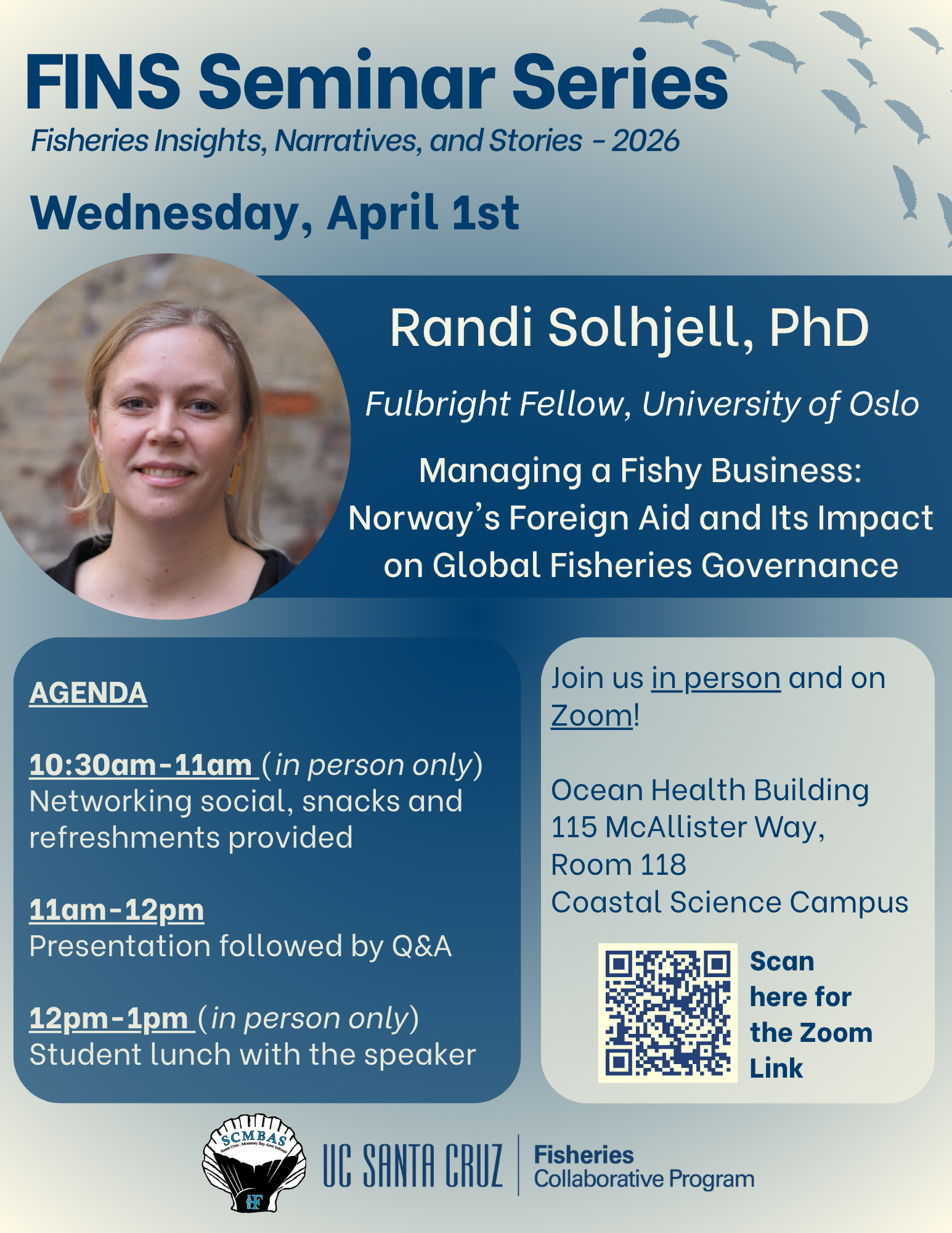
  • FINS: Fisheries Insights Narratives and Stories seminar series featuring Dr. Randi Solhjell

    Ocean Health Building McAllister Way, Santa Cruz, CA

    Please join us for the first talk in the FINS: Fisheries Insights Narratives and Stories seminar series featuring Fulbright Fellow Dr. Randi Solhjell. Her talk, “Managing a Fishy Business: Norway’s foreign aid and its impact on global fisheries governance” will discuss how Norwegian actors shape global fisheries policy through diplomacy, regulatory innovation and engagement in international institutions such as the UN FAO. She will also discuss how she studies fisheries from a social/political science lens. Preceding the talk please join us for a networking coffee hour (snacks provided) and a student-only lunch after the talk.

  • CSE Colloquium – Messages from across the event horizon:  AI Agentic Design for Computer Architecture (and more generalizable learnings)

    Engineering 2 Engineering 2 1156 High Street, Santa Cruz, CA

    Presenter: Christopher Fletcher, UC Berkeley Abstract: It is difficult to escape the hype of agentic coding.  Is the hype real?  Are we still living in ~Summer 2025 — when AI coding would accomplish little more than upset its human supervisor?  Or has a level shift in technology finally arrived? In this talk I will argue the latter.  I will […]

    Free
  • BME 280B Seminar: Small changes, Big consequences: Modulators of Alphavirus Assembly

    Biomedical Sciences Building 575 McLaughlin Drive

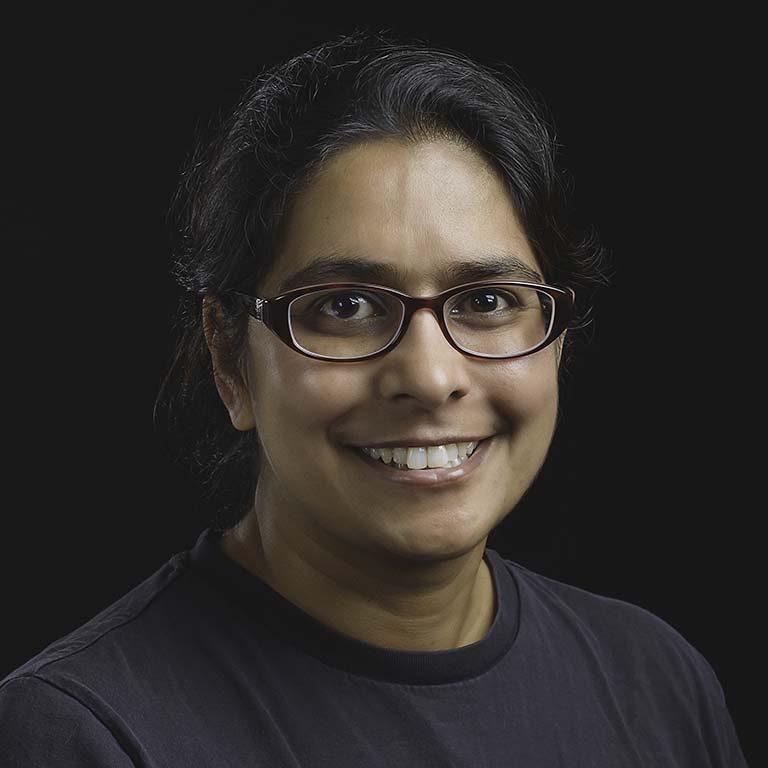
    Presenter: Dr. Suchetana (Tuli) Mukhopadhyay, Professor, Indiana University Description: N/A Bio: Suchetana “Tuli” Mukhopadhyay, Ph.D., is a professor in the Department of Biology at Indiana University, Bloomington. She received her B.A. in chemistry from DePauw University and her Ph.D. in chemistry from the University of Illinois at Chicago. Following her doctoral studies, Mukhopadhyay conducted postdoctoral […]

  • BME 80G Seminar: To Infinity and Beyond? Ethical, legal, and social issues of human research in space”

    Jack Baskin Auditorium 191 Baskin Cir, Santa Cruz, CA

    Presenter: Vaso Rahimzadeh, Assistant Professor, Baylor College of Medicine Description: As humans venture farther into outer space, new scientific discovery awaits including in genomics; but so do new ethical dilemmas.  Who bears the risks (and rewards) of space exploration and how should humanity ethically expand beyond our planet? This session will have students think critically […]

  • AM Seminar: The Thinking Eye: AI That Sees, Reads, and Reasons in Medicine

    Presenter: Yuyin Zhou, Assistant Professor, UCSC Description: Medical AI is undergoing a profound transformation, evolving from simple pattern recognition to systems capable of complex clinical reasoning. This talk will chart this evolution across three dimensions: data, models, and evaluation. I will first highlight the shift from limited, unimodal datasets to massive multimodal resources. In particular, […]

  • Statistics Seminar: Some Recent Results on Transfer Learning

    Presenter: Oscar Hernan Madrid Padilla, Assistant Professor, University of California, Los Angeles Description: In the first part of the talk, I will introduce TRansfer leArning via guideD horseshoE prioR (TRADER), a novel approach enabling multi-source transfer through pre-trained models in high-dimensional linear regression. TRADER shrinks target parameters towards a weighted average of source estimates, accommodating […]

  • Rethinking Stemflow: Distribution, Infiltration, and Isotopic Insights in Forests

    Juan Andres Pinos from the University of Nevada, Las Vegas In Person Location: ISB 221 Zoom Link Stemflow represents a spatially concentrated and chemically enriched flux of intercepted precipitation that delivers water and solutes to near‐stem soils. Conventional approaches neglect potential heterogeneity in stemflow redistribution aboveground and its subsurface infiltration pathways, introducing bias into forest […]

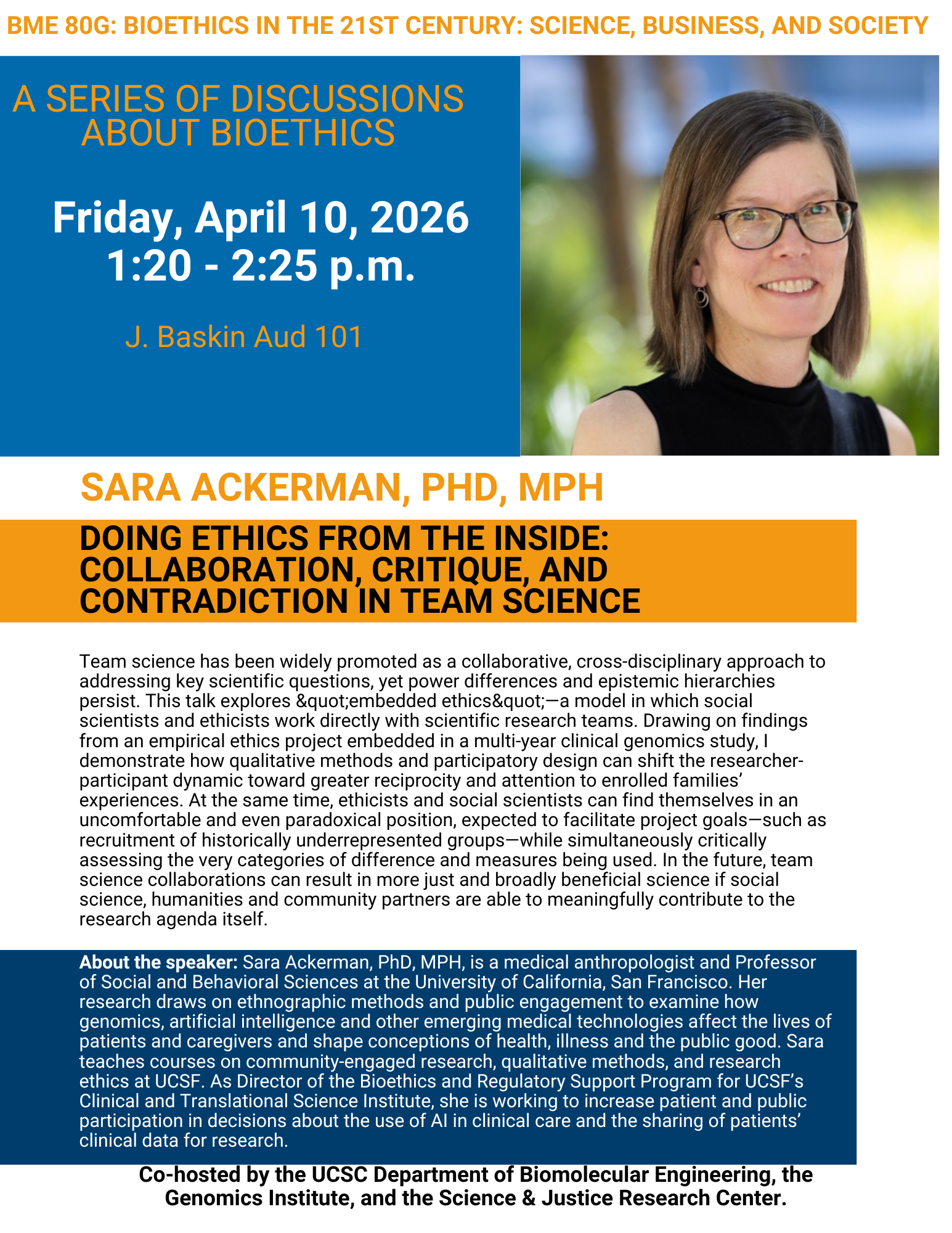
  • BME 80G Seminar: Sara Ackerman – Doing Ethics From The Inside: Collaboration, Critique, and Contradiction in Team Science

    Jack Baskin Auditorium 191 Baskin Cir, Santa Cruz, CA

    Presenter: Sara Ackerman, Medical Anthropologist and Professor of Social and Behavioral Sciences, University of California, San Francisco Description: Team science has been widely promoted as a collaborative, cross-disciplinary approach to addressing key scientific questions, yet power differences and epistemic hierarchies persist. This talk explores "embedded ethics"—a model in which social scientists and ethicists work directly […]

  • 2026 Right Livelihood International Conference

    Hybrid Event

    The Right Livelihood International Conference is a five-week global conference exploring how education can strengthen democracy, collective intelligence, and just futures. Bringing together Right Livelihood Laureates, students, faculty, and community partners […]

  • ECE 290 Seminar: Speaker Dr. Josh Star-Lack – Photon Counting Detectors for X-Ray Computed Tomography

    Engineering 2 Engineering 2 1156 High Street, Santa Cruz, CA

    Presenter: Dr. Josh Star-Lack, Principal Scientist and Research Manager, Varex Imaging Inc Description: X-ray computed tomography (CT) provides rapid, detailed 3D imaging of internal organs, bones, and vasculature. By enabling the swift diagnosis of cancer, cardiac disease, neurological disorders, and other pathologies, CT has revolutionized medicine—reducing the need for invasive exploratory surgeries and facilitating precise […]

  • BME 80G Seminar: Speaker Dr. Mohammed Mostajo-Radji – How Close Are We to Consciousness in a Dish?

    Jack Baskin Auditorium 191 Baskin Cir, Santa Cruz, CA

    Presenter: Dr. Mohammed Mostajo-Radji, Associate Research Scientist, Genomics Institute UCSC Description: We can now grow small pieces of human brain tissue in the lab, known as brain organoids. These models show many features of early brain development, including different types of neurons and coordinated electrical activity. This progress raises a fascinating question: how close are […]