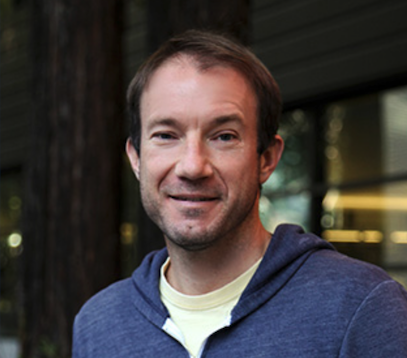
• Rethinking Stemflow: Distribution, Infiltration, and Isotopic Insights in Forests

    Juan Andres Pinos from the University of Nevada, Las Vegas In Person Location: ISB 221 Zoom Link Stemflow represents a spatially concentrated and chemically enriched flux of intercepted precipitation that delivers water and solutes to near‐stem soils. Conventional approaches neglect potential heterogeneity in stemflow redistribution aboveground and its subsurface infiltration pathways, introducing bias into forest […]
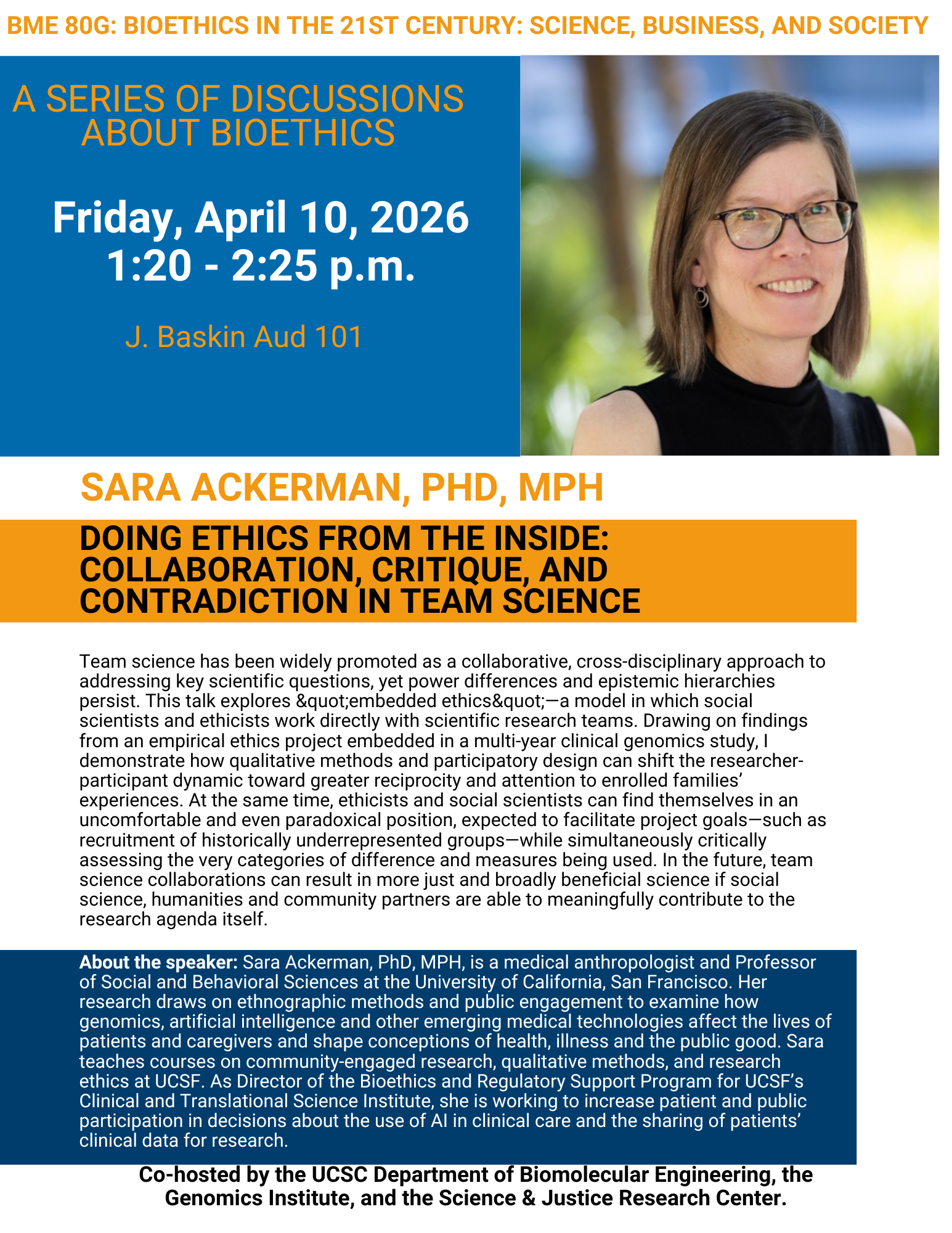

  • BME 80G Seminar: Sara Ackerman – Doing Ethics From The Inside: Collaboration, Critique, and Contradiction in Team Science

    Jack Baskin Auditorium 191 Baskin Cir, Santa Cruz, CA

    Presenter: Sara Ackerman, Medical Anthropologist and Professor of Social and Behavioral Sciences, University of California, San Francisco Description: Team science has been widely promoted as a collaborative, cross-disciplinary approach to addressing key scientific questions, yet power differences and epistemic hierarchies persist. This talk explores "embedded ethics"—a model in which social scientists and ethicists work directly […]

  • 2026 Right Livelihood International Conference

    Hybrid Event

    The Right Livelihood International Conference is a five-week global conference exploring how education can strengthen democracy, collective intelligence, and just futures. Bringing together Right Livelihood Laureates, students, faculty, and community partners across continents, the conference combines asynchronous learning with participatory dialogue and collaborative action. Rather than advocating specific outcomes, the conference positions education as a democratic […]

  • ECE 290 Seminar: Speaker Dr. Josh Star-Lack – Photon Counting Detectors for X-Ray Computed Tomography

    Engineering 2 Engineering 2 1156 High Street, Santa Cruz, CA

    Presenter: Dr. Josh Star-Lack, Principal Scientist and Research Manager, Varex Imaging Inc Description: X-ray computed tomography (CT) provides rapid, detailed 3D imaging of internal organs, bones, and vasculature. By enabling the swift diagnosis of cancer, cardiac disease, neurological disorders, and other pathologies, CT has revolutionized medicine—reducing the need for invasive exploratory surgeries and facilitating precise […]

  • BME 80G Seminar: Speaker Dr. Mohammed Mostajo-Radji – How Close Are We to Consciousness in a Dish?

    Jack Baskin Auditorium 191 Baskin Cir, Santa Cruz, CA

    Presenter: Dr. Mohammed Mostajo-Radji, Associate Research Scientist, Genomics Institute UCSC Description: We can now grow small pieces of human brain tissue in the lab, known as brain organoids. These models show many features of early brain development, including different types of neurons and coordinated electrical activity. This progress raises a fascinating question: how close are […]

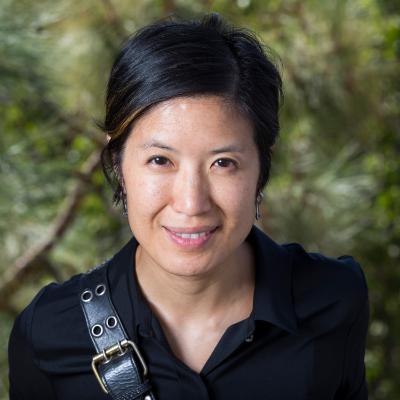
  • Ants Play Rock, Paper Scissors: Implications for Pest Control in Coffee Farms

    Ivette Perfecto from the University of Michigan In Person Location: ISB 221 Zoom Link The question of how species coexist in ecological communities has fascinated ecologists since the time of Darwin. Historically, it has been assumed that ecological communities dominated by competitive interactions exhibit transitive competition. This means there is a hierarchy of competitive strength […]

  • Statistics Seminar: Calibration Weighting-Style Diagnostics for Nonlinear Bayesian Hierarchical Models

    Presenter: Dr. Ryan Giordano, UC Berkeley Statistics Description: Multilevel Regression with Post-stratification (MrP) has become a workhorse method for estimating population quantities using non-probability surveys, and is the primary alternative to traditional survey calibration weights, e.g.~ as computed by raking. For simple linear regression models, MrP methods admit “equivalent weights”, allowing for direct comparisons between […]

  • AM Seminar: Genetically Admixed Groups as a Laboratory for Mathematical Modeling and Discovery

    Jack Baskin Engineering Baskin Engineering 1156 High Street, Santa Cruz, CA

    Presenter: Dr. Aw, Department of Genetics, University of Pennsylvania Description: Admixed groups consist of individuals descended from two or more historically separated ancestral populations, and they are underrepresented in biomedical studies. Admixed individuals are unique in that they carry mosaics of ancestral segments within their genome, so their genetic information is typically summarized as a […]

  • Nursing School Info Session with UPENN and Johns Hopkins

    Humanities 1 Building 257 Cowell-Stevenson Road, Santa Cruz, CA, United States

    University of Pennsylvania and Johns Hopkins Schools of Nursing each offer accelerated nursing programs for individuals looking to transition to the field from non-nursing degrees. 

    We will cover program overview, admissions and career outcomes.

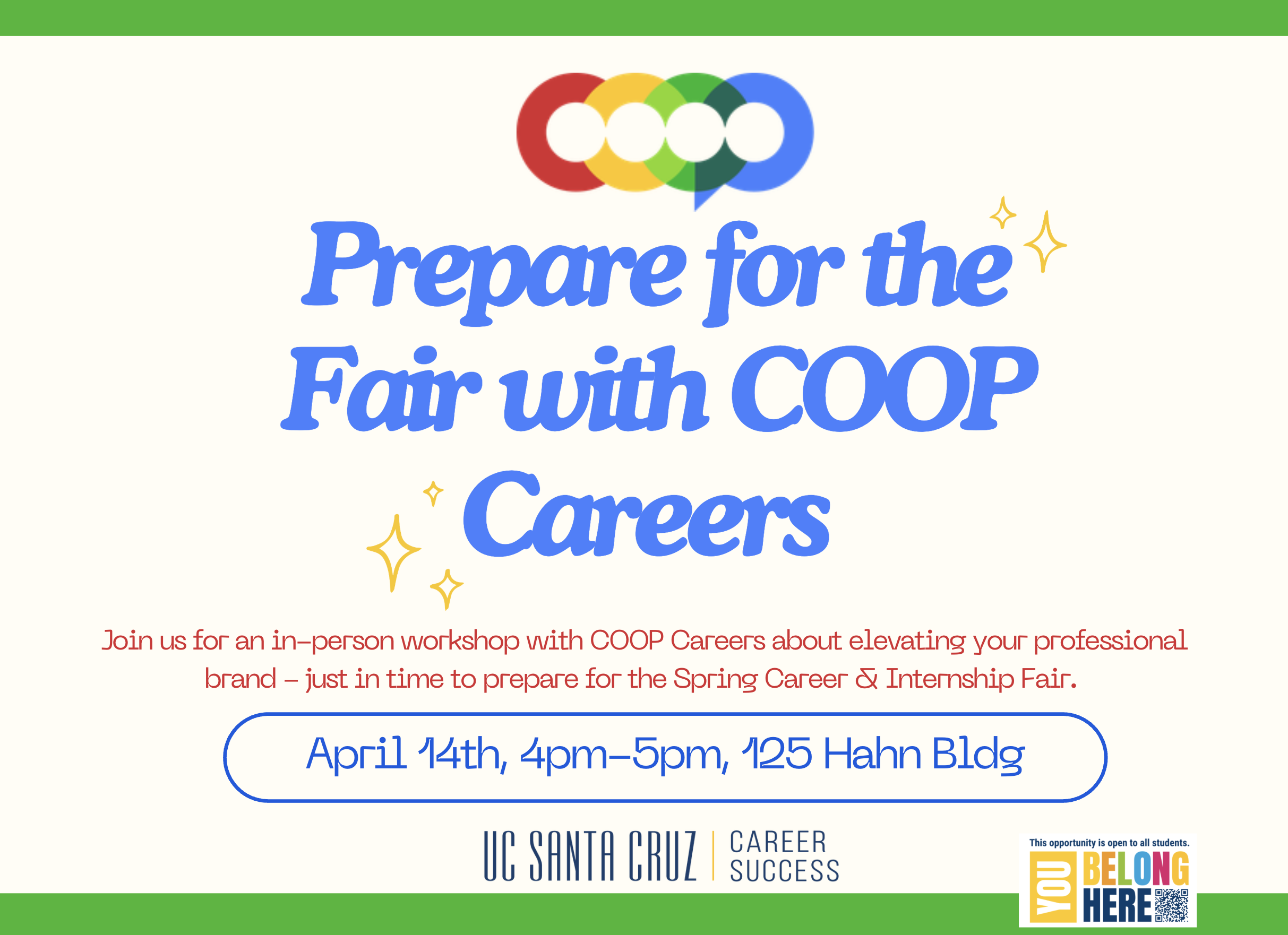
  • Prepare for the Fair with COOP Careers

    Career Success Student Lounge (125 Hahn) 1156 High Street, Santa Cruz, CA, United States

    Join us for an in-person workshop with COOP Careers about elevating your professional brand – just in time to prepare for the Spring Career & Internship Fair.

    This session will help students craft a compelling professional pitch, tailor their resume to stand out to employers, and network meaningfully with industry professionals. Don’t miss this chance to get fair-ready and set yourself up for success!

  • FINS: Fisheries Insights Narratives and Stories seminar series featuring Dr. George Leonard

    Ocean Health Building McAllister Way, Santa Cruz, CA

    Please join us for the second talk in the FINS: Fisheries Insights Narratives and Stories seminar series featuring Adjunct Professor Dr. George Leonard. His talk, “Lessons learned from my time at the science-policy interface” will discuss his extensive experience at the ocean science-policy interface at major nonprofits (Monterey Bay Aquarium and Ocean Conservancy). He initiated, developed, and led a host of conservation programs during his time at Ocean Conservancy including offshore aquaculture, plastics pollution, ocean acidification, climate change, mesopelagic fisheries, and deep-sea mining. During his early career at Monterey Bay Aquarium, he developed the scientific foundation for the nascent sustainable seafood movement. Preceding the talk please join us for a networking coffee hour (snacks provided) and a student-only lunch after the talk.

  • CSE Colloquium – Algorithmic Problems in Discrete Choice by Ravi Kumar

    Engineering 2 Engineering 2 1156 High Street, Santa Cruz, CA

    Presenter: Ravi Kumar, Google Abstract: In discrete choice, a user selects one option from a finite set of available alternatives, a process that is crucial for recommendation systems applications in e-commerce, social media, search engines, etc.  A popular way to model discrete choice is through Random Utility Models (RUMs).  RUMs assume that users assign values to […]

    Free
  • Building Soil with Microbes: Compost as Biological Infrastructure

    Keisha Ernst from the Catalyst Bio-Amendments and Compost Academy In Person Location: ISB 221 Zoom Link In this talk, Keisha will explore how biologically focused compost production differs from conventional composting systems designed primarily for waste diversion. She will discuss how microbial communities influence soil structure, nutrient cycling, plant resilience, and water dynamics—and how managing […]

  •  Waste and Cataclysm, Waste as Catalyst: The Politics of Disposability in New Orleans

    Christopher Lang from the UCSC Environmental Studies Department In Person Location: ISB 221 Zoom Link Lang explores the politics of disposability in New Orleans, Louisiana, revealing how pollution intersects with Black community health, waste workers’ lives and livelihoods, and the city’s overall resilience in the face of increasing flood risk. Using a combination of methods […]

  • AM Seminar: Variational Inference and Density Estimation with Non-Negative Tensor Train

    Presenter: Dr. Xun Tang, Stanford University Description: This talk covers an efficient numerical approach for compressing a high-dimensional discrete distribution function into a non-negative tensor train (NTT) format. The two settings we consider are variational inference and density estimation, whereby one has access to either the unnormalized analytic formula of the distribution or the samples […]

  • Statistics Seminar: Hierarchical Clustering with Confidence

    Presenter: Snigdha Panigrahi, Associate Professor, Department of Statistics, University of Michigan Description:Agglomerative hierarchical clustering is one of the most widely used approaches for exploring how observations in a dataset relate to each other. However, its greedy nature makes it highly sensitive to small perturbations in the data, often producing different clustering results and making it […]

  • CSE Colloquium – Robust Machine Learning for Biomedical Data: Efficiency, Reliability, and Generalizability

    Engineering 2 Engineering 2 1156 High Street, Santa Cruz, CA

    Presenter Chenyu You, Stony Brook University Abstract In the rapidly growing area of machine learning, there is profound promise in crafting intelligent, data-driven methods for diverse real-world applications. Yet, in safety-critical domains like healthcare, some fundamental challenges remain: (1) The insufficiency of raw biomedical data emphasizes the need for data-efficient and robust learning approaches. (2) […]

    Free
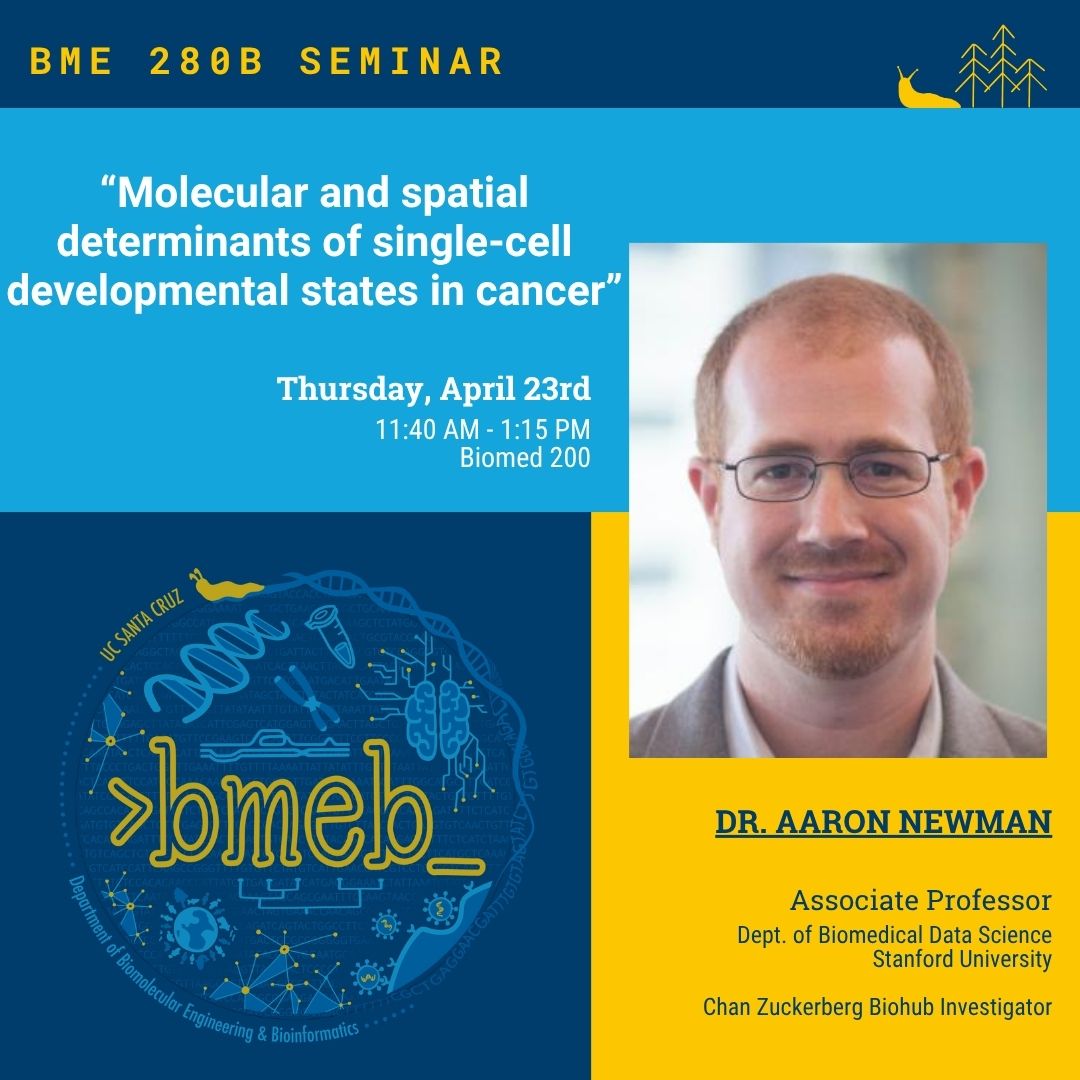
  • BME 280B Seminar: Speaker Dr. Aaron Newman – Molecular and spatial determinants of single-cell developmental states in cancer

    Biomedical Sciences Building 575 McLaughlin Drive

    Presenter: Dr. Newman, Associate Professor in the Department of Biomedical Data Science, Stanford University   Description: Determining the factors that shape cell potency—the ability of a cell to differentiate into other cell types—is essential for understanding tissue biology in health and disease, including cancer. In previous work, we found that single-cell transcriptional diversity decreases across […]

  • BME80G Seminar: Ed Green, “DNA Forensics in The Genomics Age”

    Jack Baskin Auditorium 191 Baskin Cir, Santa Cruz, CA

    Presenter: Richard “Ed” Green, Professor of Bimolecular Engineering @ UCSC Bio: Richard E. Green (Ed) was born in Atlanta, Georgia, USA in 1972. He graduated from the University of Georgia (B.Sc. Genetics) in 1997. Before graduate school, Ed was in Peace Corps (Barentu, Eritrea) and was a lab tech at Emory University. Ed studied with Steven […]

  • ECE 290 Seminar: Speaker Luat T. Vuong – Biospeculative approaches to the “needle in a haystack”: vortex encoders and hybrid optical neural-networks

    Engineering 2 Engineering 2 1156 High Street, Santa Cruz, CA

    Presenter: Luat Vuong, Associate Professor in Mechanical Engineering, UC Riverside Description: Given the growing computational demands of machine learning, how can we scale approaches for sifting through large volumes of data—including patterned or delayed information embedded as “noise”? Many computer vision applications have a strict power budget and demand robust, rapid-response, and even real-time image […]