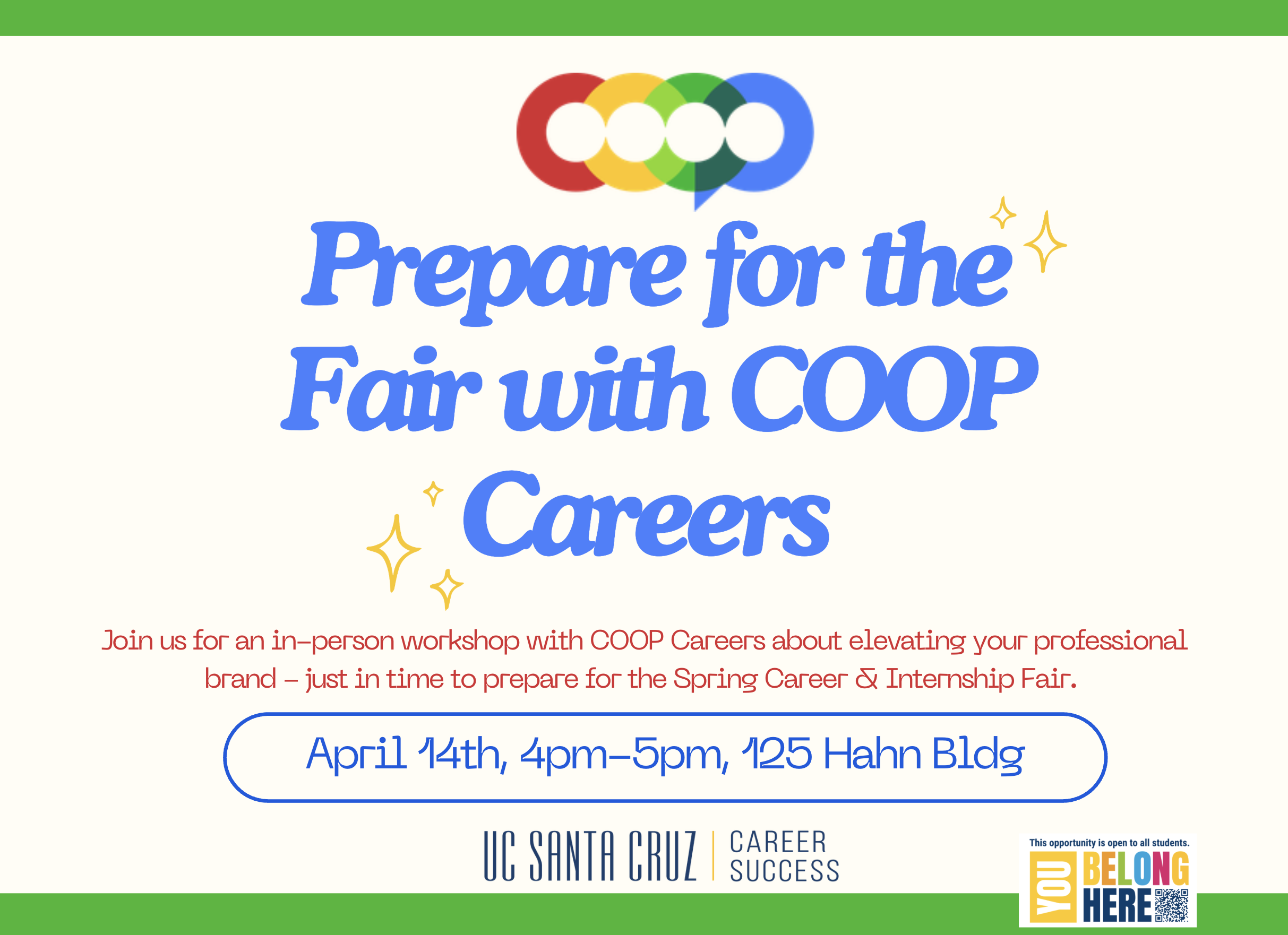
• Prepare for the Fair with COOP Careers

    Career Success Student Lounge (125 Hahn) 1156 High Street, Santa Cruz, CA, United States

    Join us for an in-person workshop with COOP Careers about elevating your professional brand – just in time to prepare for the Spring Career & Internship Fair.

    This session will help students craft a compelling professional pitch, tailor their resume to stand out to employers, and network meaningfully with industry professionals. Don’t miss this chance to get fair-ready and set yourself up for success!
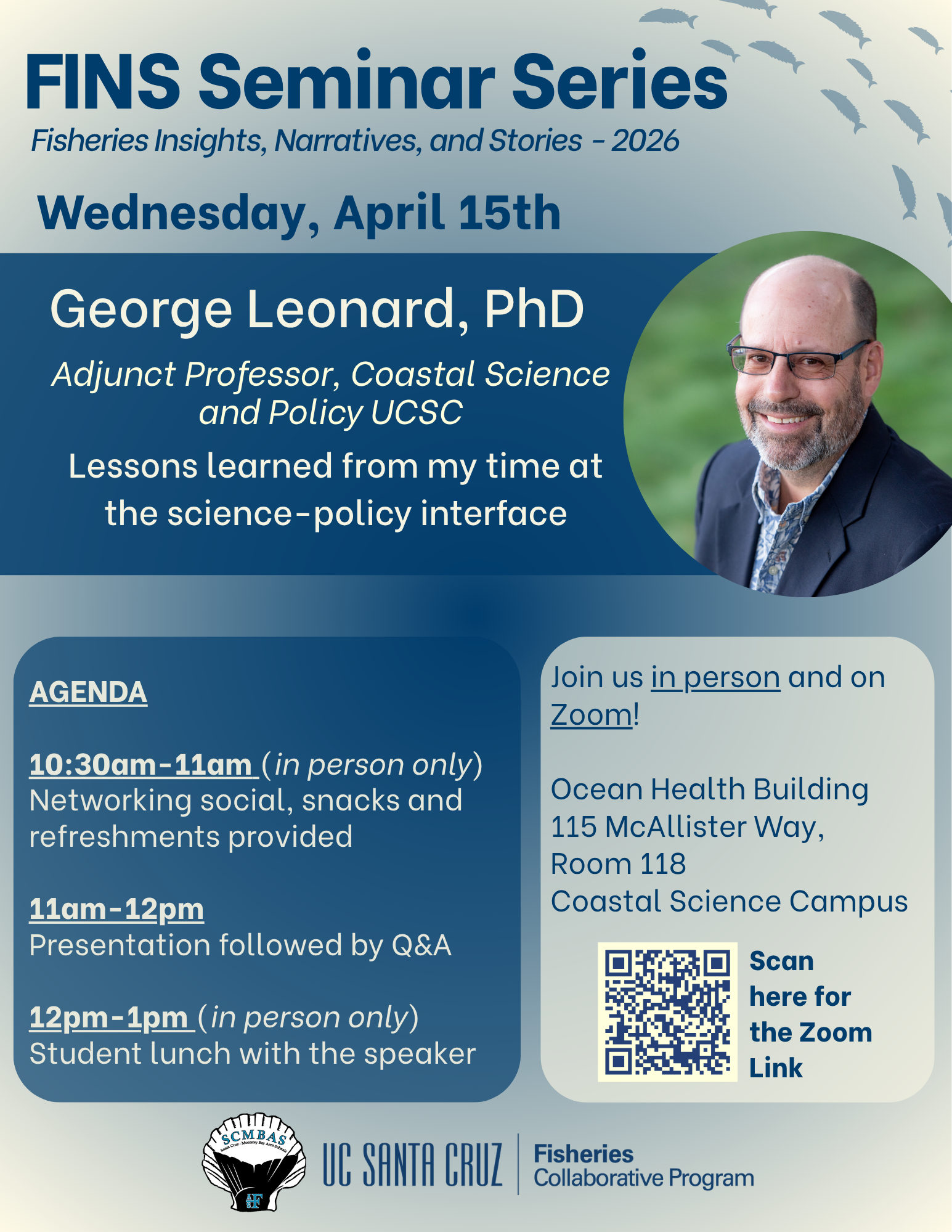
  • FINS: Fisheries Insights Narratives and Stories seminar series featuring Dr. George Leonard

    Ocean Health Building McAllister Way, Santa Cruz, CA

    Please join us for the second talk in the FINS: Fisheries Insights Narratives and Stories seminar series featuring Adjunct Professor Dr. George Leonard. His talk, “Lessons learned from my time at the science-policy interface” will discuss his extensive experience at the ocean science-policy interface at major nonprofits (Monterey Bay Aquarium and Ocean Conservancy). He initiated, developed, and led a host of conservation programs during his time at Ocean Conservancy including offshore aquaculture, plastics pollution, ocean acidification, climate change, mesopelagic fisheries, and deep-sea mining. During his early career at Monterey Bay Aquarium, he developed the scientific foundation for the nascent sustainable seafood movement. Preceding the talk please join us for a networking coffee hour (snacks provided) and a student-only lunch after the talk.

  • CSE Colloquium – Algorithmic Problems in Discrete Choice by Ravi Kumar

    Engineering 2 Engineering 2 1156 High Street, Santa Cruz, CA

    Presenter: Ravi Kumar, Google Abstract: In discrete choice, a user selects one option from a finite set of available alternatives, a process that is crucial for recommendation systems applications in e-commerce, social media, search engines, etc.  A popular way to model discrete choice is through Random Utility Models (RUMs).  RUMs assume that users assign values to […]

    Free
  • Building Soil with Microbes: Compost as Biological Infrastructure

    Keisha Ernst from the Catalyst Bio-Amendments and Compost Academy In Person Location: ISB 221 Zoom Link In this talk, Keisha will explore how biologically focused compost production differs from conventional composting systems designed primarily for waste diversion. She will discuss how microbial communities influence soil structure, nutrient cycling, plant resilience, and water dynamics—and how managing […]

  •  Waste and Cataclysm, Waste as Catalyst: The Politics of Disposability in New Orleans

    Christopher Lang from the UCSC Environmental Studies Department In Person Location: ISB 221 Zoom Link Lang explores the politics of disposability in New Orleans, Louisiana, revealing how pollution intersects with Black community health, waste workers’ lives and livelihoods, and the city’s overall resilience in the face of increasing flood risk. Using a combination of methods […]

  • AM Seminar: Variational Inference and Density Estimation with Non-Negative Tensor Train

    Presenter: Dr. Xun Tang, Stanford University Description: This talk covers an efficient numerical approach for compressing a high-dimensional discrete distribution function into a non-negative tensor train (NTT) format. The two settings we consider are variational inference and density estimation, whereby one has access to either the unnormalized analytic formula of the distribution or the samples […]

  • Statistics Seminar: Hierarchical Clustering with Confidence

    Presenter: Snigdha Panigrahi, Associate Professor, Department of Statistics, University of Michigan Description:Agglomerative hierarchical clustering is one of the most widely used approaches for exploring how observations in a dataset relate to each other. However, its greedy nature makes it highly sensitive to small perturbations in the data, often producing different clustering results and making it […]

  • CSE Colloquium – Robust Machine Learning for Biomedical Data: Efficiency, Reliability, and Generalizability

    Engineering 2 Engineering 2 1156 High Street, Santa Cruz, CA

    Presenter Chenyu You, Stony Brook University Abstract In the rapidly growing area of machine learning, there is profound promise in crafting intelligent, data-driven methods for diverse real-world applications. Yet, in safety-critical domains like healthcare, some fundamental challenges remain: (1) The insufficiency of raw biomedical data emphasizes the need for data-efficient and robust learning approaches. (2) […]

    Free
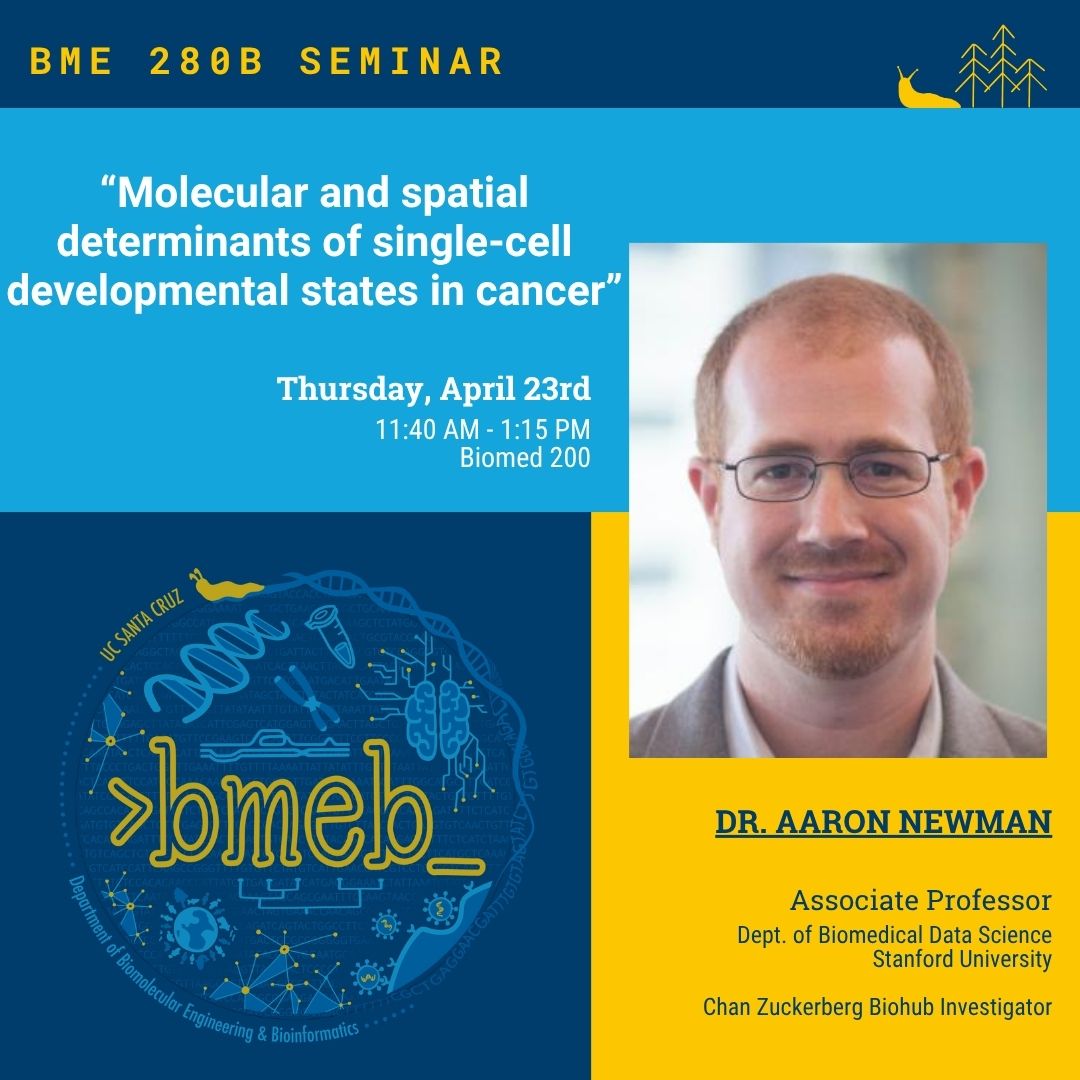
  • BME 280B Seminar: Speaker Dr. Aaron Newman – Molecular and spatial determinants of single-cell developmental states in cancer

    Biomedical Sciences Building 575 McLaughlin Drive

    Presenter: Dr. Newman, Associate Professor in the Department of Biomedical Data Science, Stanford University   Description: Determining the factors that shape cell potency—the ability of a cell to differentiate into other cell types—is essential for understanding tissue biology in health and disease, including cancer. In previous work, we found that single-cell transcriptional diversity decreases across […]

  • BME80G Seminar: Ed Green, “DNA Forensics in The Genomics Age”

    Jack Baskin Auditorium 191 Baskin Cir, Santa Cruz, CA

    Presenter: Richard “Ed” Green, Professor of Bimolecular Engineering @ UCSC Bio: Richard E. Green (Ed) was born in Atlanta, Georgia, USA in 1972. He graduated from the University of Georgia (B.Sc. Genetics) in 1997. Before graduate school, Ed was in Peace Corps (Barentu, Eritrea) and was a lab tech at Emory University. Ed studied with Steven […]

  • ECE 290 Seminar: Speaker Luat T. Vuong – Biospeculative approaches to the “needle in a haystack”: vortex encoders and hybrid optical neural-networks

    Engineering 2 Engineering 2 1156 High Street, Santa Cruz, CA

    Presenter: Luat Vuong, Associate Professor in Mechanical Engineering, UC Riverside Description: Given the growing computational demands of machine learning, how can we scale approaches for sifting through large volumes of data—including patterned or delayed information embedded as “noise”? Many computer vision applications have a strict power budget and demand robust, rapid-response, and even real-time image […]

  • CM Seminar: Edward Wang, “Inventing a New Blood Pressure Monitor”

    Silicon Valley Campus 3175 Bowers Avenue, Santa Clara, CA, United States

    Presented by: Edward Wang Description: “What does it actually look like to invent something? In this talk, I trace the decade-long journey of turning a smartphone into a blood pressure monitor, from Seismo, which used smartphone accelerometers to measure pulse transit time, to BPClip, a dollar clip that brought calibration-free oscillometry to the fingertip, to VibroBP, which […]

  • Socio-Ecological Complexity in Coffee Agroecosystems

    Sanya Cowal from the UCSC Environmental Studies Department In Person Location: ISB 221 Zoom Link One of the most pressing global challenges considers how to combine sustainable agricultural land use with biodiversity conservation. Agricultural systems have been dramatically transformed and intensified, leading to the simplification of agricultural landscapes through increased agrochemical use, landscape homogeneity, decreased […]

  • Statistics Seminar: Active Learning for Fair and Stable Allocations

    Jack Baskin Engineering Baskin Engineering 1156 High Street, Santa Cruz, CA

    Presenter: Riddhiman Bhattacharya, Postdoc, UCSC Description: We propose an active learning approach for dynamic fair resource allocation problems. In contrast to prior work that assumes full feedback from all agents on their allocations, we focus on scenarios where feedback is available only from a carefully select subset of agents at each epoch of the online […]

  • AM Seminar: Machine Learning in Molecular Simulations: From Free Energy to Vibrational Spectroscopy

    Jack Baskin Engineering Baskin Engineering 1156 High Street, Santa Cruz, CA

    Presenter: Marcos Calegari Andrade, Assistant Professor, Chemistry and Biochemistry, UC Santa Cruz Description: In this talk, I will demonstrate how neural networks can represent the high-dimensional potential energy surfaces of many-body systems. By achieving the accuracy of first-principles quantum calculations at a fraction of the computational cost, these models enable atomistic simulations of condensed matter […]

  • CSE Colloquium – Towards Safe and Resilient Large-scale Distributed Programming

    Engineering 2 Engineering 2 1156 High Street, Santa Cruz, CA

    Presenter: Philipp Haller, KTH Royal Institute of Technology Abstract: Distributed programming is notoriously difficult. Not only are distributed systems concurrent, they pose additional challenges including data consistency and fault tolerance. At the same time, the share of software systems that are necessarily distributed systems is growing rapidly. As a result, too many software developers are […]

    Free
  • BME80G Seminar – Katherine Bonini, “Rethinking Familial Risk in Genomic Medicine: Ethical Approaches to Cascade Screening”

    Jack Baskin Auditorium 191 Baskin Cir, Santa Cruz, CA

    Presenter: Katherine Bonini, Senior Genetic Counselor @ Icahn School of Medicine at Mount Sinai   Description: It has long been argued that families are central to genomic medicine. Genomic risk, diagnosis, and management are rarely confined to a single individual, and separating patients’ interests from those of their relatives is often neither straightforward nor desirable. Despite this, […]

  • ECE 290 Seminar: Speaker – Dr. Jaeyoung Lim “Autonomous Information Gathering using Long Endurance Aerial Vehicles”

    Engineering 2 Engineering 2 1156 High Street, Santa Cruz, CA

    Presenter: Jaeyoung Lim, Postdoctoral Scholar at the Agile Robotics and Perception Lab at the Electrical Engineering and Computer Science Department, University of California, Berkeley Description: Monitoring large-scale environments is essential for natural hazard management, environmental process observation, and search and rescue operations. Yes, meaningful coverage of the target environment demands vast infrastructure and dense sensor […]

  • Statistics Seminar: Advancing Statistical Rigor in Single-Cell and Spatial Omics Using In Silico Control Data

    Jack Baskin Engineering Baskin Engineering 1156 High Street, Santa Cruz, CA

    Presenter: Guan’ao Yan, Assistant Professor, Michigan State University Description: Single-cell and spatial transcriptomics technologies now let us map cellular diversity and tissue organization at high resolution, but the computational methods built to analyze these data are difficult to evaluate in a rigorous, reproducible way. Two key barriers are the lack of realistic synthetic data with […]

  • AM Seminar: Engineering the Earth’s Climate

    Jack Baskin Engineering Baskin Engineering 1156 High Street, Santa Cruz, CA

    Presenter: Dr. Pulkit Dubey, Postdoc, UC Santa Cruz Description: Neural climate emulators such as NeuralGCM and LUCIE offer efficient, differentiable alternatives to General Circulation Models (GCMs), producing climate predictions at a fraction of the cost. While work to date has focused largely on predictive accuracy, we leverage differentiability to study control of long-horizon climatological targets. […]