• AM Seminar: Structure-Preserving Discretizations and their Applications

    Jack Baskin Engineering Baskin Engineering 1156 High Street, Santa Cruz, CA

    Presenter: Andy Wan, Assistant Professor, University of California, Merced   Description: Many models from science and engineering possess fundamental structures which are important to preserve in order for accurate and stable long-term predictions. For instance, preserving conserved quantities, such as energy, mass and momentum, are fundamental in many physical systems. Moreover, preserving dissipative quantities, such as entropy […]

  • CANCELLED – November Slugs and Steins with Associate Professor Mircea Teodorescu

    Virtual Event

    Slugs & Steins is a monthly series of informal discussions highlighting UC Santa Cruz’s amazing faculty members. Talks are held on the 2nd Monday of each month with topics ranging from organic artichokes to endangered zebras, self-driving cars to Shakespeare. All are welcome, and audience participation is encouraged. We encourage you to share the link […]

  • Words That Impress: Creating a Great Résumé & Cover Letter

    Career Success Student Lounge (125 Hahn) 1156 High Street, Santa Cruz, CA, United States

    Crafting a fantastic Resume and Cover Letter are the key to getting an interview and landing a job!  Join us for this informative workshop that will cover best practices for resume and cover letter development.  You’ll gain understanding about the perfect format, navigating AI filters, and how to write captivating resume bullet points and engaging […]

    Free
  • Petety, A. (CSE) – New Algorithmic Methods for Uncertain Inputs

    This dissertation focuses on designing and proving performance guarantees on algorithms when there is uncertainty in the input. The uncertainty could be from the user being unsure or future inputs that have not arrived yet. We look at different methods in which algorithms can be designed to be competitive against the optimal. One of the […]

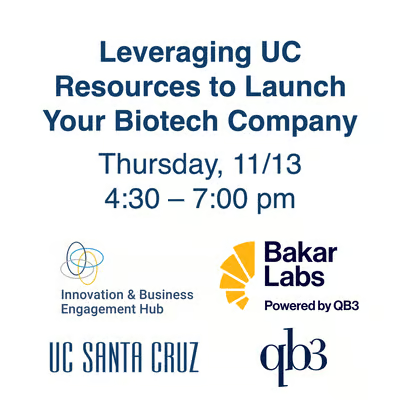
  • Leveraging UC Resources To Launch Your Biotech Company

    Hay Barn 94 Ranch View Road, Santa Cruz, CA, United States

    Are you a UCSC faculty member, postdoc, or graduate student with an entrepreneurial mindset? Join us for an insightful panel discussion on how to turn your biotech research into a successful startup. Learn how to tap into the University of California’s robust innovation ecosystem—from research commercialization and funding opportunities to mentorship and startup incubation. Hear […]

  • ECE 290 Seminar: Low-Power and Miniaturized Medical Electronics for in vivo Localization and Tracking

    Presenter: Dr. Saransh Sharma, Postdoctoral Scholar, MIT Description: Accurate in vivo localization of medical devices is central to applications ranging from ingestible pills in the GI tract to endovascular and minimally invasive procedures. However, current clinical methods rely on endoscopy or repeated ionizing imaging (CT/X-ray), and are poorly suited for continuous or out-of-hospital use. In […]

  • CM Seminar: “Playful Design to Empower Climate Adaptation – What are we missing for real-life impact?”

    Engineering 2 Engineering 2 1156 High Street, Santa Cruz, CA

    Presented by: Linda Hirsch   Description: “Games and playful interventions have been researched to increase awareness of climate change impacts and educate about mitigation and adaptation measures. However, besides increased awareness, what real-life impact and adapted behaviors can we actually observe from such interventions? In this talk, I will reflect on the differences between short-term […]

  • AM Seminar: Dynamo Action Inside the Giant Planets

    Presenter: Dr. Paula Wulff, UCLA Description: Our solar system hosts six unique planetary magnetic fields. Intrinsic magnetic fields are generated deep inside planets by dynamo action. This process requires regions of electrically conducting material and energy sources to maintain the dynamo. Thus, we can learn about the deep interiors of planets, including their structures and […]

  • Statistics Seminar: Beyond the Average Treatment Effect: Causal Mediation Methods for Understanding Intervention Mechanisms

    Presenter: Hanna Kim, Assistant Professor, Psychology Department, UCSC Description: Understanding how an intervention works is a central question in behavioral and social research, following the demonstration of its overall effect. Traditional mediation analysis techniques often assume a homogeneous mechanism of effects, overlooking both validity concerns and subgroup variation in causal pathways. In this talk, I […]

  • CSE Colloquium – Flux: Refinement Types for Verified Rust Systems

    Engineering 2 Engineering 2 1156 High Street, Santa Cruz, CA

    Presenter: Ranjit Jhala, UCSD Abstract: Rust has risen as a language of choice for new systems code — from OS kernels to hypervisors, firmware and run-times — as it is memory safe and provides the sort of abstractions needed for efficient low-level systems implementation. We present Flux, a refinement type checker for Rust that shows how […]

    Free
  • Jorquera, Z. (CSE) – Quantum Entanglement Bounds and the Approximation Algorithms That Use Them

    Engineering 2 Engineering 2 1156 High Street, Santa Cruz, CA
    Hybrid Event

    One of the central challenges in quantum computing is finding or approximating the ground-state energy of a local Hamiltonian, a quantum analogue of classical constraint satisfaction problems (CSPs). Among these, the Quantum Max-Cut problem serves as a canonical example, paralleling the classical Max-Cut problem. Despite its foundational importance in both theoretical computer science and condensed […]

  • GradWiC Womxn’s Lunch – Lunch & Learn

    Join Graduate Womxn in Computing (GradWiC) for our Womxn’s Luncheon this Thursday, from 1-2 pm in E2-599. This week, we are having a Lunch & Learn session featuring Kat Kosolapova from CSE.

  • Ramollari, H. (ECE) – An Optofluidic Spectrometer and Applications in Biosensing

    Engineering 2 Engineering 2 1156 High Street, Santa Cruz, CA
    Hybrid Event

    Miniaturized spectrometers have the potential to replace bulky and expensive benchtop models. We have previously demonstrated a multimode interference (MMI) waveguide-based spectrometer that achieves high performance while minimizing its footprint. In this talk, the integration of the MMI spectrometer into an optofluidic device is proposed. This integration opens up applications such as the detection of […]

  • Torres, S. (ECE) – An Integrated Platform for Real-time Monitoring and Support of 3D Tissue Growth

    Virtual Event

    Organoids are three-dimensional tissue cultures that model real organs and serve as valuable tools for studying development, disease, and treatment response. Traditional methods, which rely on manual handling and incubators, limit consistency and real-time monitoring. To address these issues, we developed a modular microfluidic platform that integrates automated feeding, live fluorescence imaging, and environmental control […]

  • Chen, Q. (CSE) – New Approximation and Online Algorithms using Novel Combinatorial Structures

    Hybrid Event

    Most optimization problems face the challenge of computing an optimum solution requiring superpolynomial time. In particular, they are classified as NP-hard problems that have no polynomial-time algorithm to date. Instead, computer scientists turn to find an approximate solution and create numerous elegant algorithms. However, in the modern era, computational environments have changed drastically, and we […]

  • ECE 290 Seminar: Fundamental Nanopower Analog Circuits

    Presenter: Joey Sankman, Analog/Power Designer, Analog Devices Description: With the rising interest in edge computing, and the addition of AI/ML functionality, nanopower circuits are in great demand to reduce the quiescent power consumption of remote sensors. In this tutorial, fundamental building blocks for nanopower circuits will be covered, including startup-less low-voltage references, low-frequency clocks, and […]

  • AM Seminar: Linear Stochastic Emulators of the Ocean Circulation based on Balanced Truncation: A Caution, perhaps, for Machine Learning?

    Presenter: Professor Andy Moore, UCSC Ocean Sciences Description: Linear inverse models have enjoyed considerable popularity in the geosciences, particularly in the arena of climate research and climate prediction, for several decades as a straightforward approach to dimension reduction and streamlining computational efficiency. The most common approach is to truncate the system by retaining the leading […]