
BME 280B Seminar: Dr. Mark Chaisson – “Multiscale analysis of variation in repetitive DNA across human genomes”
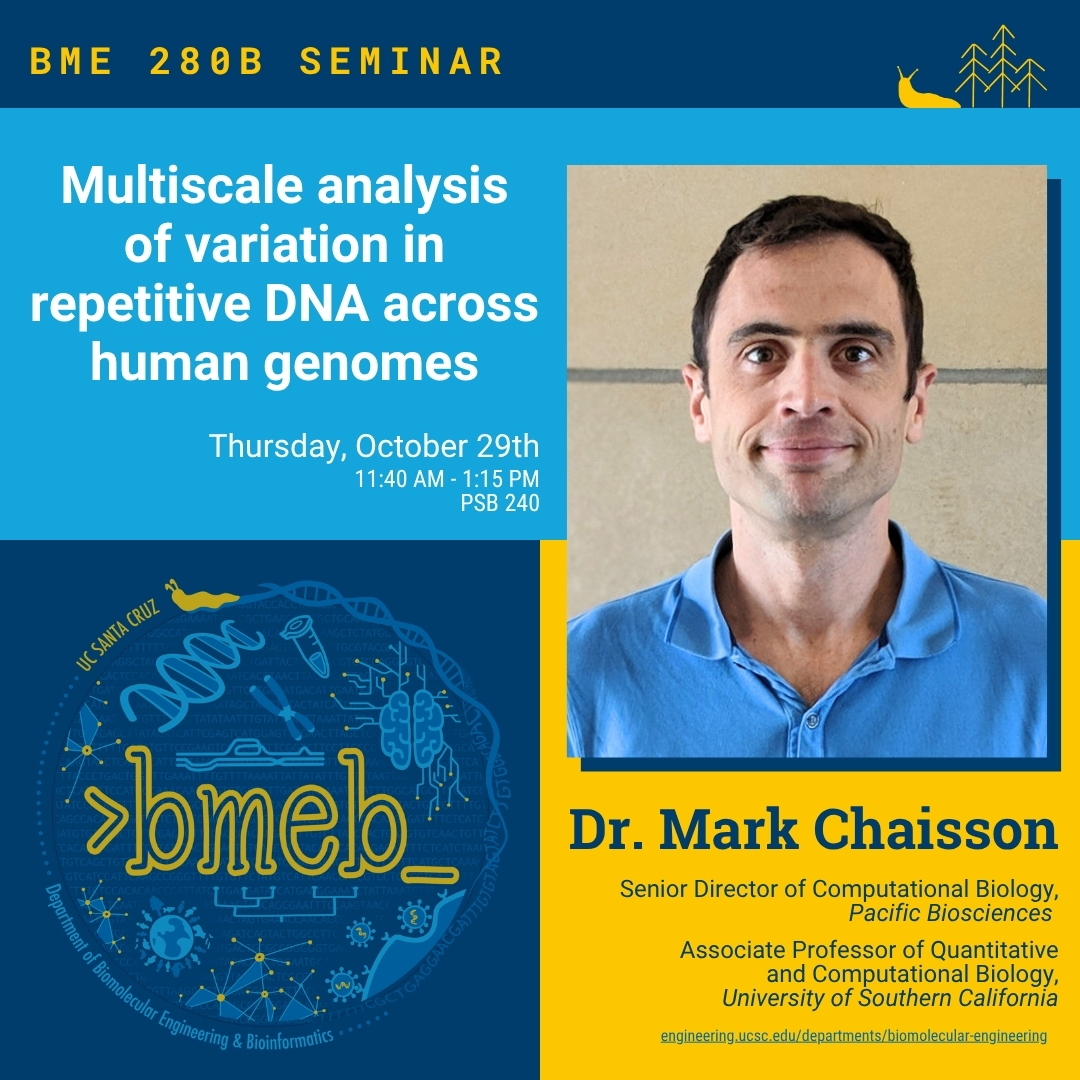
Welcome to the 5th week of our BME 280B seminar series, a weekly seminar covering topics of current research in computational biology and bioinformatics.
Open to all, food is provided. Class enrollment is not required.
Please join us this week to learn more about the works of Dr. Mark Chaisson:
Title of Talk: Multiscale analysis of variation in repetitive DNA across human genomes
Presenter: Dr. Mark Chaisson, Senior Director of Computational Biology at Pacific Biosciences and Associate Professor, University of Southern California
Description: Efforts from the Human Pangenome Reference Consortium, the Human Genome Structural Variation Consortium, and other large-scale sequencing efforts have produced near telomere-to-telomere, haplotype-resolved maps of variation across human populations. The magnitude of variation of the euchromatic genome is well-characterized at a high level;each genome has roughly 25,000 structural variants (SVs), including insertions, deletions, and rearrangements of at least 50 bases, and contains about 10 million bases of DNA beyond the GRCh38 reference. Characterizing the nature of these additional sequences and of variation at large reveals that the majority of variation exists as gains or losses of repetitive DNA. By count, the majority of SVs (>60%) are in short-tandem repeats (STRs) and variable-number tandem repeats (VNTRs), and the majority of bases of SVs are from changes in copy-number variable genes.
Methods that describe variation as simple gains and losses of DNA may miss insight from more specific algorithms designed to analyze repetitive sequences. We present three separate approaches to analyze repetitive DNA at scales ranging from short-tandem repeats to copy-number variable genes. First, we map STR and VNTR length and motif variation using a tandem repeat annotation tool, vamos, and use this to build a population-scale database of tandem repeat variation, TRCompDB. Using population demography, we derive site-specific mutation rates and mechanisms for tandem repeats. We next extend this analysis to measure the impact of length and motif variation in tandem repeats on gene expression using brain samples in collaboration with the Center for Alzheimer’s and Related Dementias. We then demonstrate an approach, FastSD, for sparse alignment of large libraries of monomer sequences to annotate the repeat composition of centromeric DNA, demonstrating domain structure and population stratification of monomers. Finally, we present an approach, ctyper, to genotype databases of sequence-resolved copy-number variable genes derived from long-read assemblies into short read cohorts, demonstrating population diversity of copy-number variable genes and the impact of sequence-resolved copy-number variation on gene expression.
Bio: Dr. Chaisson is the Senior Director of Computational Biology at Pacific Biosciences and is an Associate Professor at the University of Southern California. He received his PhD in Bioinformatics from the University of California, San Diego. He has held positions as a Senior Algorithms Engineer at Pacific Biosciences and Postdoctoral Scholar at the University of Washington. His research focuses on computational method development to analyze population-scale sequencing data.
Hosted by: Professor of Biomolecular Engineering, Dr. Benedict Paten