
BME 280B Seminar: Dr. Ed Green – “The DNA Legacy of Thomas Jefferson”
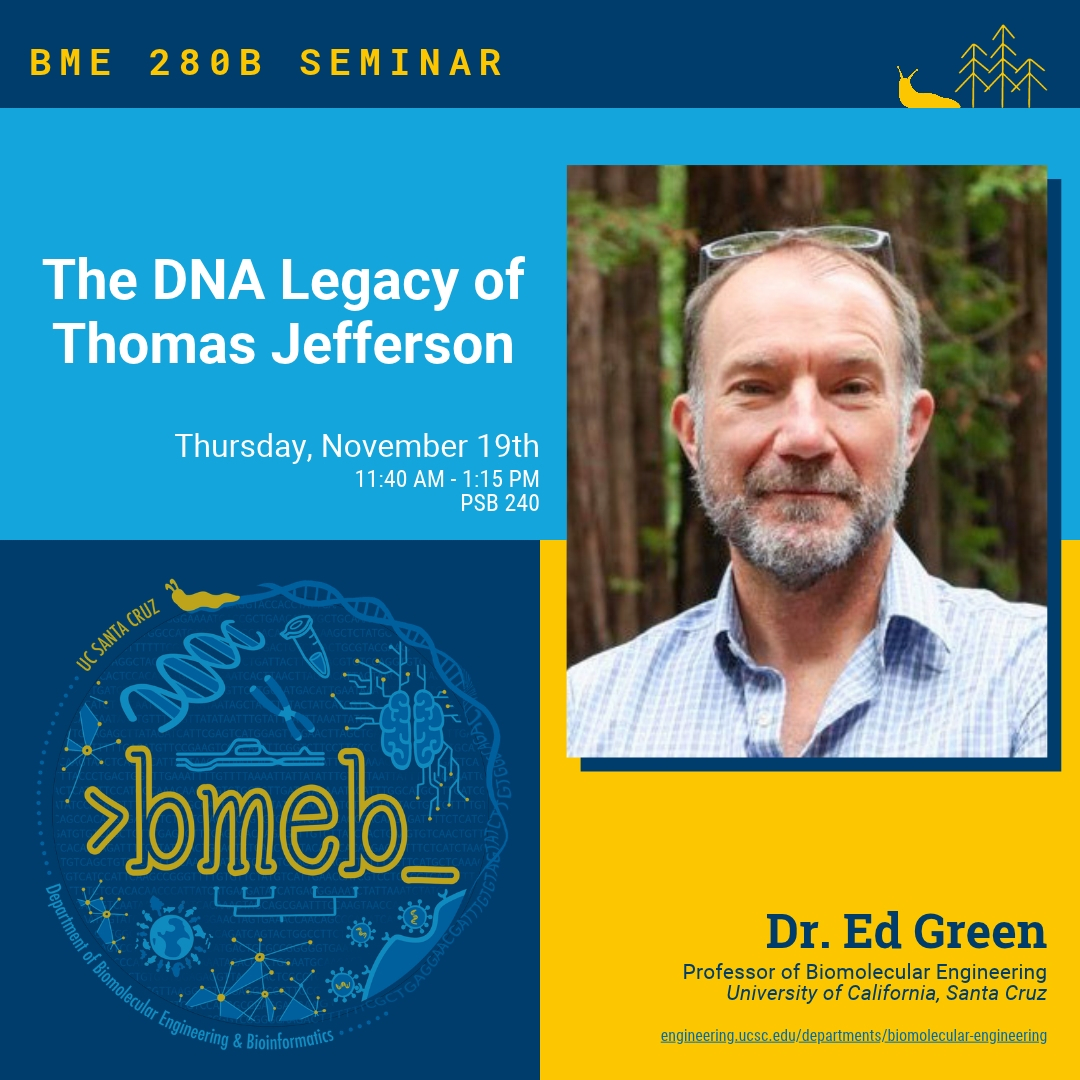
Welcome to the 8th week of our BME 280B seminar series, a weekly seminar covering topics of current research in computational biology and bioinformatics.
Open to all, food is provided. Class enrollment is not required.
Please join us this week to learn more about the works of Dr. Richard Ed Green:
Title of Talk: The DNA Legacy of Thomas Jefferson
Presenter: Dr. Ed Green, Professor of Biomolecular Engineering, University of California, Santa Cruz
Description: Allegations that Thomas Jefferson fathered the children of the enslaved Sally Hemings emerged in the context of U.S. presidential politics in the late 1700s and early 1800s and entailed strongly contested denials and affirmations by family members, biographers, and historians ever since. Previous analysis of Y chromosome markers in contemporary members of the Jefferson and Hemings patrilines was consistent with the paternity hypothesis but rejected by those who pointed out that, absent Jefferson’s DNA and its direct comparison to the DNA of possible descendants, other Jefferson males could have fathered Sally Hemings’ children. In this study, we developed an innovative technique to recover DNA from multiple rootless hair samples in a museum collection whose provenance, mitochondrial genomes, Y chromosome markers, and identity to each other indicate that these hairs and the DNA from them are from Thomas Jefferson. Using these DNA data, we find clear evidence of Thomas Jefferson ancestry in descendants of both his wife Martha Wayles Jefferson and Sally Hemings. We measured the amount of identical-by-descent DNA shared between Thomas Jefferson and his known and putative descendants. We find that the amount of shared Jefferson DNA is more likely under the model of direct Thomas Jefferson paternity than other proposed scenarios.
Bio: Richard E. Green (Ed) was born in Atlanta, Georgia, USA in 1972. He graduated from the University of Georgia (B.Sc. Genetics) in 1997. Before graduate school, Ed was in Peace Corps (Barentu, Eritrea) and was a lab tech at Emory University. Ed studied with Steven Brenner at the University of California, Berkeley where he got his PhD in 2005 on computational algorithms for sequence analysis and alternative splicing. As an NSF Postdoctoral Fellow in the lab of Svante Paabo at the Max Planck Institute for Evolutionary Anthropology, Ed pioneered the use of high-throughput sequencing in ancient DNA. He was first author of the paper in Science describing the Neanderthal genome which won the Newcombe-Cleveland prize. As Professor at the University of California, Santa Cruz, Ed co-directs the UCSC Paleogenomics lab. His research focuses on comparative genomics, population genetics, DNA technology development, and DNA-based forensics. Ed is co-founder of Dovetail Genomics, Claret Biosciences, and Astrea Forensics. He is a Kavli Scholar, a Searle Scholar and a Sloan Scholar, author of over 100 research manuscripts and 21 US Patents. He is a senior member of the National Academy of Inventors, was a 2024 Santa Cruz Titan of Tech, and was awarded the 2025 International Homicide Investigators Association technology award.