
BME 280B Seminar: Dr. Kiley Graim “Beyond the Majority: Correcting for Genetic Ancestry Bias in Disease Genomics”
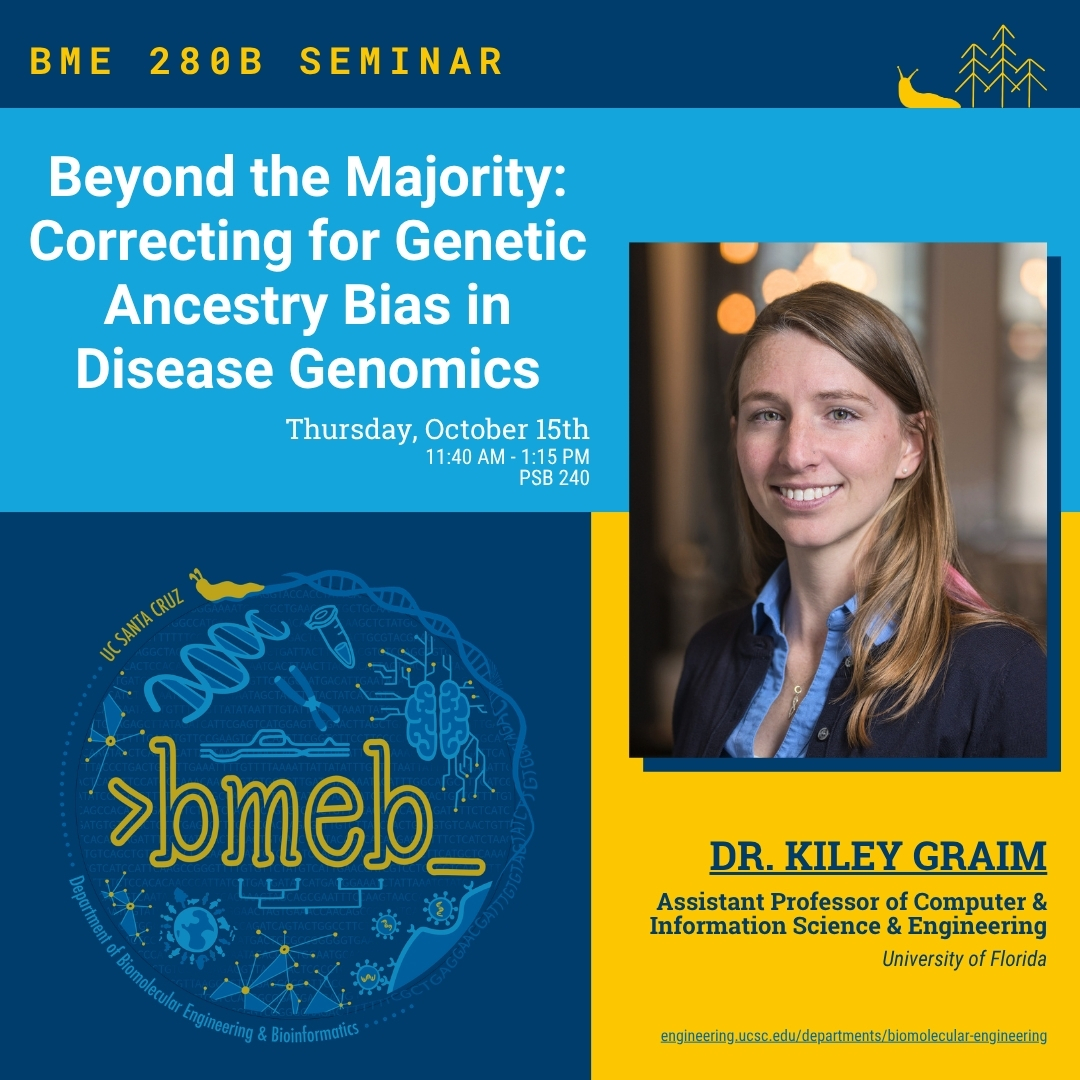
Welcome to the 3rd week of our BME 280B seminar series, a weekly seminar covering topics of current research in computational biology and bioinformatics.
Open to all, food is provided. Class enrollment is not required.
Please join us this week to learn more about the works of Dr. Kiley Graim:
Presenter: Dr. Kiley Graim, Assistant Professor of Computer & Information Science & Engineering, University of Florida
Description: Advances in high-throughput sequencing have transformed disease genomics, yet persistent sampling biases continue to confound downstream analyses. Omics datasets remain overwhelmingly enriched for individuals of European ancestry, introducing population stratification that is frequently conflated with disease-relevant signals. This is compounded by the fact that local adaptation has shaped allele frequency distributions differentially across ancestral populations, producing lineage-specific variants that modulate both disease susceptibility and drug response. AI models often fail to generalize across populations, exacerbating disparities in precision medicine. I will present approaches for mitigating these confounds by integrating population-scale genomic resources (e.g., gnomAD, 1000 Genomes) with comparative evolutionary genomics across species, enabling ancestry-aware and cross-species-informed modeling strategies for more generalizable disease genomics.
Bio: Dr. Kiley Graim is an Assistant Professor in the Department of Computer & Information Science & Engineering at the University of Florida. She earned a B.S. and M.S. in Computer Science from Colorado State University and a Ph.D. in Biomolecular Engineering from the University of California, Santa Cruz, followed by postdoctoral training at the Simons Foundation and Princeton University. Her research combines biology, genomics, and computer science to develop multi-omic artificial intelligence methods for identifying the molecular drivers of human disease. Her lab’s research spans cancer evolution across mammalian species, precision medicine, equitable AI, and sepsis.
Hosted by: Professor of Biomolecular Engineering, Dr. Benedict Paten