
BME 280B Seminar: Valery Ortiz and Joseph Cruz
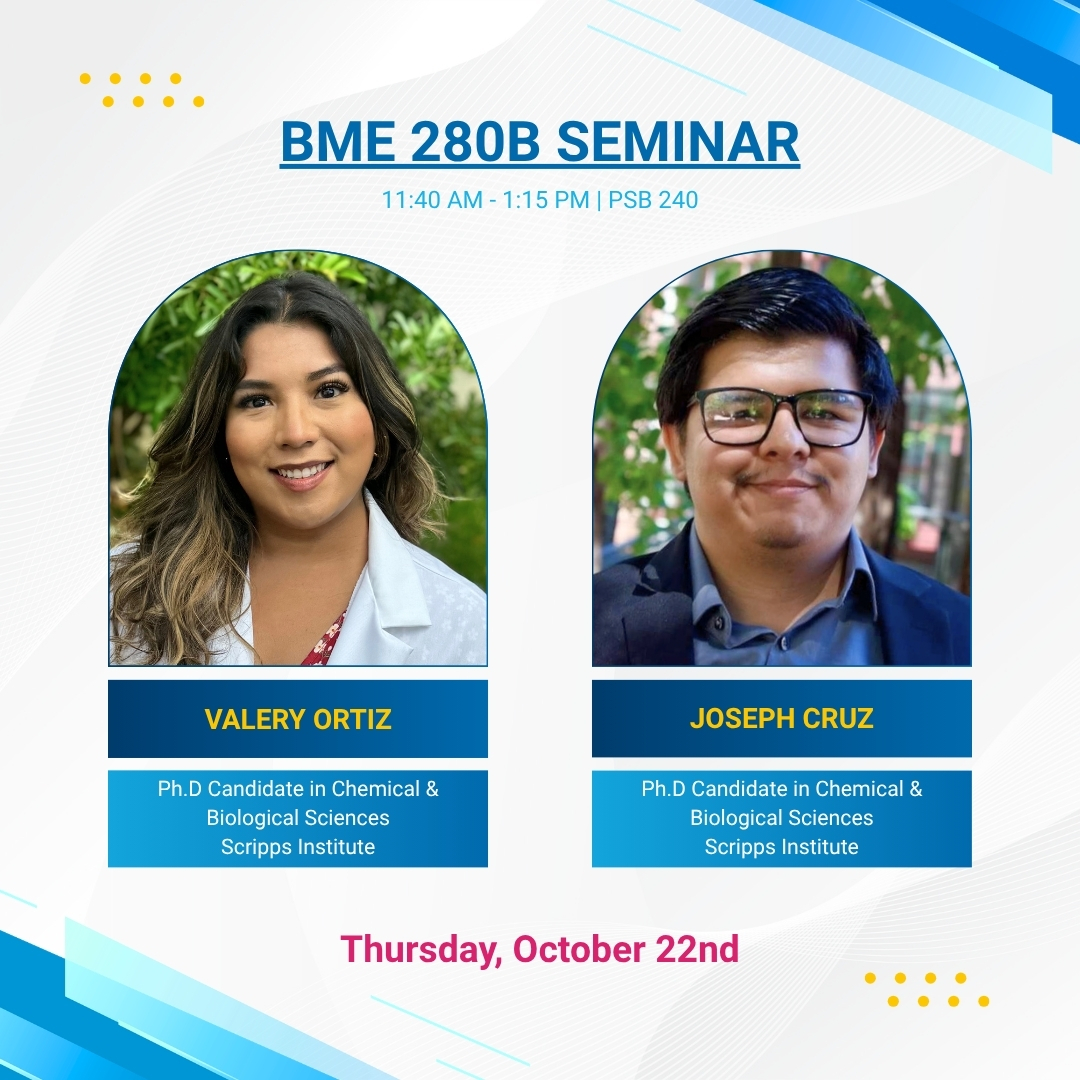
Welcome to the 4th week of our BME 280B seminar series, a weekly seminar covering topics of current research in computational biology and bioinformatics.
Open to all, food is provided. Class enrollment is not required.
Please join us this week to learn more about our two speakers, Valery Ortiz and Joseph Cruz:
Title: Structural Insights into the Infection Mechanism of Mycobacteriophages Using Cryo-Electron Tomography
Presenter: Valery Ortiz, 4th Year Ph.D Candidate in the Chemical & Biological Science Program, Scripps Research Institute
Description: Mycobacterial infections, including tuberculosis (TB) and nontuberculous mycobacterial (NTM) diseases, remain a major global health threat, worsened by the rise of multidrug-resistant strains. This study investigates the potential of therapeutic phages, particularly Fionnbharth (FB), to target drug-resistant Mycobacterium infections. Optimizing phage therapy requires a basic understanding of phage structural and mechanistic properties. Using Mycobacterium smegmatis mc² 155 (M. smegmatis) as a model organism, we used cryo-electron tomography (cryo-ET) to visualize phage-host interactions in near-native conditions, focusing on attachment, intracellular replication, and structural organization. Samples were prepared at a multiplicity of infection (MOI) of 300 for attachment studies and MOIs of 3–15 for replication time points ranging from 30 minutes to 2 hours post-infection. Cryo-focused ion beam (cryo-FIB) milling generated ~200 nm-thick lamellae, enabling visualization of the bacterial interior. Tomographic imaging revealed a temporal progression of intracellular replication intermediates, including procapsids, empty capsids, and DNA-filled capsids, demonstrating capsid formation and maturation over time. Organized arrays of tail filaments were also observed, providing direct structural evidence of the FB replication cycle inside M. smegmatis. Subtomogram averaging of ~500 FB particles revealed two major tail-tip conformations at the bacterial surface: a rounded tail-tip positioned near the membrane at various angles and a flat, tightly aligned complex perpendicular to the membrane. These preliminary data suggest distinct pre- and post-attachment states. Together, these results highlight the power of cryo-ET to investigate structural changes in therapeutic phages throughout infection, advancing our broader understanding of the structural virology underlying phage-host interactions.
Bio: Valery Ortiz is a 4th year PhD candidate in the Chemical and Biological Sciences Program at Scripps Research Institute in La Jolla in the Department of Integrative Structural and Computational Biology, where she conducts her doctoral research in Dr. Raphael Park’s lab. Her research focuses on therapeutic bacteriophages that infect mycobacteria and uses structural biology approaches, including cryo-electron tomography and single particle Cryo-EM, to understand how phages interact with and infect bacterial cells. Through this work, she hopes to contribute to the development of phage-based therapies for difficult-to-treat mycobacterial infections, including tuberculosis.
Valery earned her B.S. in Biochemistry and Molecular Biology from UC Santa Cruz, where she conducted undergraduate research in Dr. Needhi Bhalla’s lab studying meiosis and chromosome biology in C. elegans. During her time at UCSC, she was also a MARC Scholar through the STEM Diversity Programs, which played an important role in her development as a researcher and in her preparation for graduate school.
Title: Structural Characterization of HCV Entry-Fusion and Neutralizing Antibody Epitopes for Immunogen Design
Presenter: Joseph Cruz, Ph.D Candidate in Chemical & Biological Sciences, Scripps Research Institute
Description: Hepatitis C Virus (HCV) infects liver cells through a multistep entry process that has remained a major virological and immunological challenge for three decades. HCV first attaches to the host receptor scavenger receptor class B type 1 (SR-BI) via the E2 HVR-1 region, then binds a second receptor, CD81, before being internalized through clathrin-mediated endocytosis in a process that also involves the entry factors claudin-1 and occludin. Despite this established sequence of events, the molecular structures underlying these interactions and how they physically drive viral entry remain undefined. Once inside the cell, fusion occurs within endosomes, where low pH triggers a poorly understood structural change in the viral envelope glycoprotein complex, E1E2, that allows the virus to merge with the host membrane. While E1E2 was originally thought to resemble fusion proteins found in related viruses like dengue and Zika, recent evidence suggests it instead represents a unique class of fusion proteins. This further supported by the newly resolved structure of E1E2 as a dimer of heterodimers showing a envelope organization different from Zika and Dengue virus. However, this structure’s appearance on intact viral particles remains unconfirmed. HCV’s ability to evade the immune system and resist neutralizing antibodies has made vaccine development equally difficult. One promising strategy for addressing both challenges is to define the molecular structure of E1E2 during entry and fusion, alongside the epitopes and mechanisms used by broadly neutralizing antibodies (bnAbs) capable of blocking many different HCV strains. I am currently using cryo-electron tomography and single-particle cryo-electron microscopy to structurally characterize E1E2’s interactions with host entry factors, its pre- and post-fusion states, and in complex with bnAbs. Together, these structural insights will provide a mechanistic understanding of antibody neutralization to guide rational vaccine design.
Bio: Joseph Cruz is a Ph.D. candidate in Chemical and Biological Sciences at Scripps Research Institute, where he studies entry-fusion mechanisms and broadly neutralizing antibody responses against Hepatitis C Virus, working under the mentorship of Dr. Mansun Law and Dr. Donghyun (Raphael) Park. As a first-generation college student, Joseph began his scientific training in biochemistry at Mt. San Antonio Community College before transferring to the University of California, Santa Cruz (UCSC), where he completed his B.S. in Biomolecular Engineering and Bioinformatics. While at UCSC, he was involved with the SACNAS chapter and the STEM Diversity Programs’ MARC program, where he trained under Dr. Rebecca DuBois’s mentorship, focusing on the structural characterization of Computationally Optimized Broadly Reactive Antigens (COBRAs) for Influenza A virus. Joseph’s research has consistently focused on the intersection of structural biology and virology, and his current work aims to inform the development of more effective vaccines against Hepatitis C Virus.
Hosted by: Professor of Biomolecular Engineering, Rebecca Dubois, and Director of STEMDIV Research Programs, Yuli Ortega